

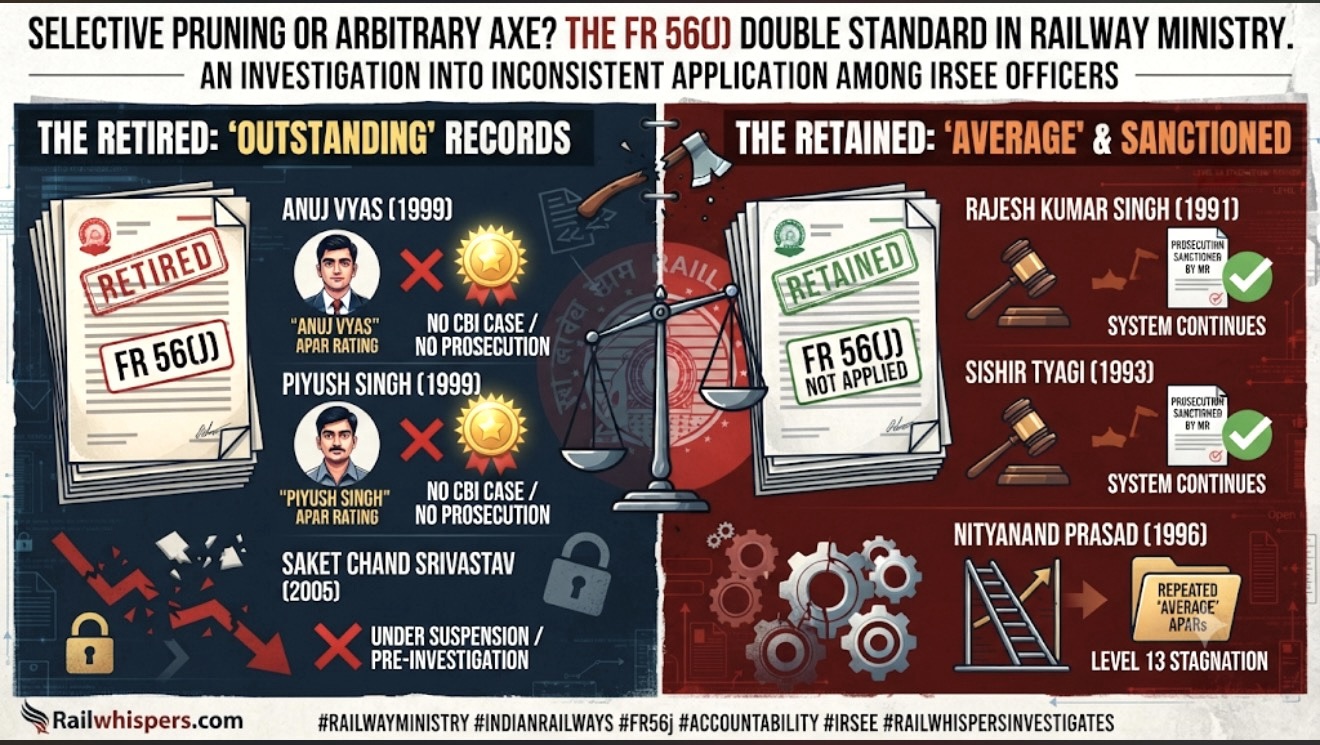
Selective Pruning or Arbitrary Axe? FR 56(j) Scrutiny Exposes Glaring Double Standards in Railway Ministry
The contrast between retaining an officer repeatedly graded “Average” in Level 13 while retiring officers with consistently “Outstanding” APARs under FR 56(j) points to a fundamental disconnect between stated policy goals and actual execution
NEW DELHI: Fundamental Rule 56(j) was conceived as a sharp administrative scalpel to remove proven ‘deadwood’ and compromised personnel from public service in the public interest. Yet an examination of service records, vigilance trajectories, and disciplinary milestones across the Indian Railway Service of Electrical Engineers (#IRSEE) points to a troubling inversion: officers with unblemished or high Annual Performance Appraisal Report (#APAR) ratings face premature retirement on the strength of departmental vigilance proceedings or preliminary suspension, while officers facing approved prosecution sanctions or prolonged career stagnation remain untouched within the system.
For an organization as safety-critical and procurement-heavy as Indian Railways, perceived arbitrariness in invoking FR 56(j) undermines not only institutional morale, but also the credibility of anti-corruption and efficiency reviews themselves.
Departmental Vigilance vs. Prosecution Sanctions: A Tale of Two Standards
Under Fundamental Rule 56(j), the appropriate authority holds the power to prematurely retire a government servant in the public interest, provided the decision is grounded in objective assessment of integrity, competence, and overall service record rather than whim or punitive overreach.
In practice, however, the contrast across documented cases raises sharp questions about consistency:
- Premature retirement without CBI cases or prosecution: Two IRSEE 1999-batch officers, Anuj Vyas and Piyush Singh, were prematurely retired under FR 56(j) despite having no active CBI cases and no ongoing prosecution proceedings against them, relying instead solely on departmental vigilance cases—even though both officers had consistently earned “Outstanding” APAR gradings.
- Invocation during suspension before CBI investigation began: Saket Chand Srivastav (IRSEE 2005 batch), formerly Sr. DEE/G/DLI, had FR 56(j) invoked against him while under suspension and before a CBI investigation had even commenced.
- Approved prosecution sanctions without FR 56(j): Conversely, Rajesh Kumar Singh (IRSEE 1991 batch), CEE/Plg/NR, and Shishir Tyagi (IRSEE 1993 batch), Dy. CEE/BLW, were not subjected to FR 56(j) even where prosecution was recommended by the CBI and prosecution sanction was granted by the competent authority—the Minister of Railways acting on behalf of the President of India.
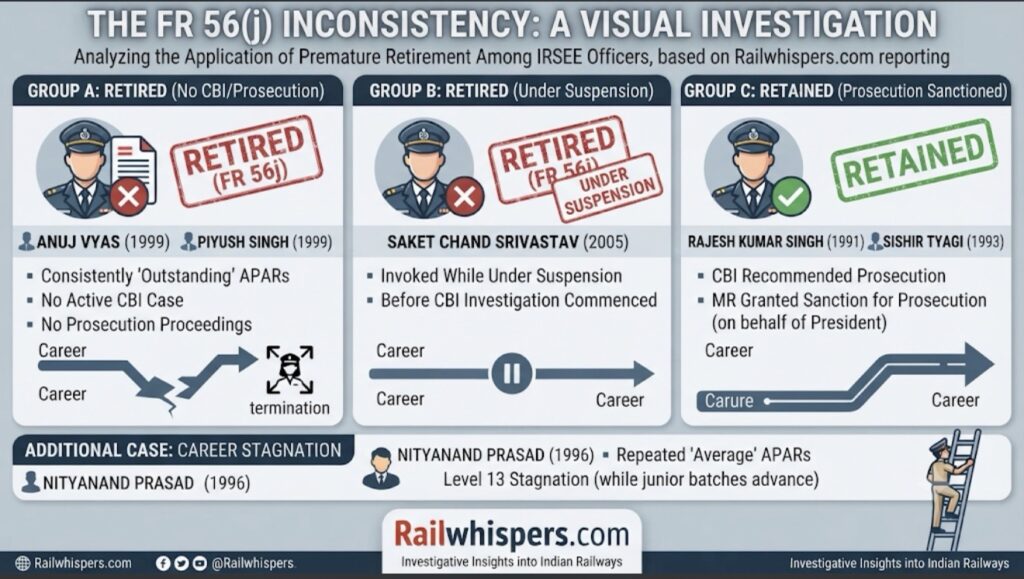
When officers facing formal prosecution sanctions or early-stage suspensions are treated so differently from those facing purely departmental vigilance scrutiny, questions naturally arise over whether FR 56(j) is being applied uniformly or selectively.
Career Stagnation and the “Deadwood” Question
The stated purpose of FR 56(j) extends beyond integrity concerns to address inefficiency and stagnation—ensuring that officers who fail to meet required standards do not remain a drag on organizational effectiveness.
The case of Nityanand Prasad (IRSEE 1996 batch) highlights this exact tension. Due to repeated “Average” APAR gradings allegedly across his career, he remains in Level 13 holding the post of Dy. CEE on Central Railway. With the IRSEE 1996 batch having passed the stage of consideration and the 1997 batch moving toward Divisional Railway Manager (DRM) assignments, his continued placement at the Dy. CEE level stands out as a stark illustration of career stagnation.
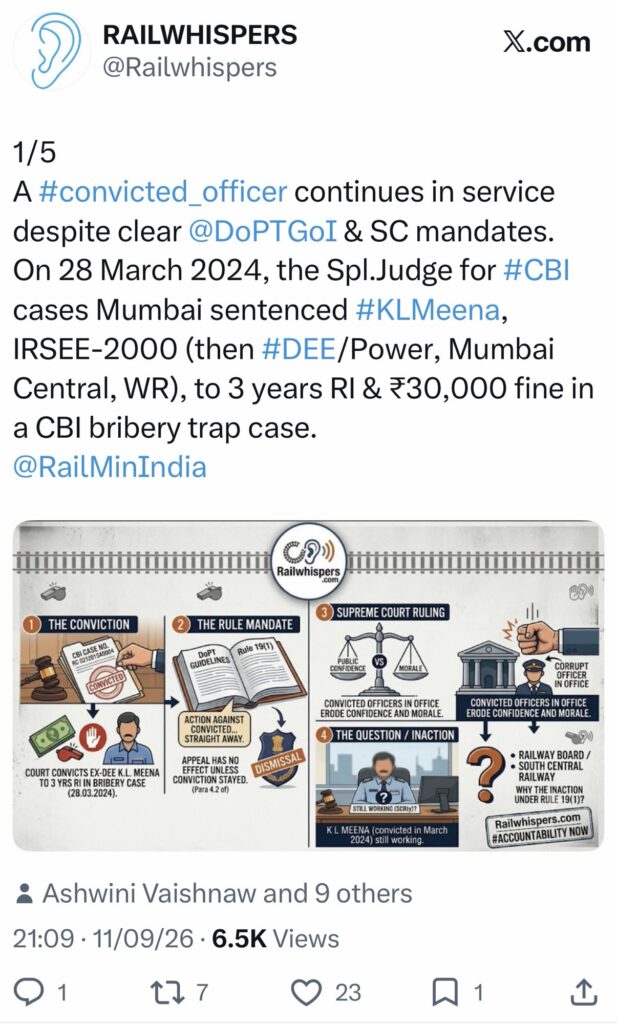
Critics argue that if FR 56(j) is intended to address both compromised integrity and genuine non-performance, the contrast between retaining an officer repeatedly graded “Average” in Level 13 while retiring officers with consistently “Outstanding” APARs under FR 56(j) points to a fundamental disconnect between stated policy goals and actual execution.
Institutional Credibility at Stake
Premature retirement under FR 56(j) carries severe professional, financial, and reputational consequences for any civil servant. Equally, failing to act decisively where prosecution sanctions have already been approved or where chronic underperformance is documented weakens the deterrent and reformative purpose of the rule.
To restore confidence in the fairness and legal defensibility of FR 56(j) reviews in the Ministry of Railways, administrative decisions must demonstrably align with settled legal principles on non-arbitrariness, proportionality, and objective record assessment—and concerned authorities should clarify the rationale behind divergent outcomes in comparable cases.
(Editorial Note: This report is based on whistleblower submissions regarding service and vigilance records; concerned railway authorities and the officers named are invited to share clarifications, official records, or their counter-views for publication.)