

Editorial: DRM Postings, Rule Bending, and Railway Reforms
For some time now, barring a few exceptions, almost all current Divisional Railway Managers (#DRMs) have been seen roaming the corridors of the Railway Board. The DRMs posted on December 2024 will soon complete their two-year tenure, and it is a matter of satisfaction that new DRMs are going to be posted without any delay.
At the same time, it is somewhat concerning that, as before, some officers still get rules changed for their personal interests. Word has come around about one such IRAS couple. Since this couple serves as Joint Secretaries in an important ministries or department and wields deep influence in the corridors of power, they are able to bend rules to suit themselves—and if it is also true that both of them are in HAG, the matter becomes very serious.
While HAG promotions in the railways’ engineering departments (Mechanical, Electrical, Civil Engineering, Signal & Telecom, Stores) have barely reached the 1991 batch, these departments with artificially high allocated posts (Traffic, Accounts, and Personnel) have moved five to six years ahead of the others. This is a major anomaly in railway administration or management.
If the practice of making DRMs in HAG takes root, it will simply be an own goal for the railways.
Accounts is a very small department in Railways, yet it has one Board Member and four Additional Members. This shows how certain departments maintain artificially fast avenues for promotion for themselves. Look at the current DRMs themselves: DRMs from the 1993 batch in a large department like Mechanical will only now complete their tenure, whereas officers from Accounts and Personnel—two to three years junior to them—will finish their tenure.
Meanwhile, insiders say that officers who crossed 52 years of age on October 31 are also getting empanelled. Although #Railwhispers has consistently opposed the restrictive age limit of 52 years, changing pre-existing rules to favour any particular officer is sheer anarchy.
It has also come to light that DRMs departing from big cities will continue in the same city from their division just as before, which would not be right according to rotation rules. Assuming that only those who have bowed their heads or submitted before your court have needs is wrong! Numerous self-respecting officers are working in remote parts of the country—when we speak with them, we hear the same thing: “Who will listen to us?”
Just as Modi ji made Joint Secretary empanelment automatic, other officers too should get a fair shot at postings in major cities. If making visits, lobbying, or pulling strings is what is needed, that is completely wrong.
DRMs are a direct part of the Chairman’s team and are directly tied to the Chairman’s agenda.
We have a slight reservation about the Chairman-CEO arrangement, though we accept that every system will have both positives and negatives! If the government wants to strengthen the CRB/CEO process, the CRB should appoint these outgoing DRMs—who are completing their tenure—on rotation to important posts, which will motivate young officers in the railway system. Ensuring that officers who have served as DRMs become General Managers and Board Members is in the government’s own interest. If the CRB has received three extensions and the government has spoken of continuity, it is very necessary that officers who have completed their DRM tenure also be viewed within that same chain of continuity, and the government’s agenda be carried forward.
Strict adherence to the rotation policy by DRMs is essential. Departments like Vigilance should be handled by them, and the Safety department should be strengthened. In a way, this is a good opportunity to create two streams: management and technical. When these officers are brought forward—into Vigilance, Safety, Construction, Operations, Planning, Training, and Transformation—it will have a far-reaching positive impact on the railway system.
Look at this:
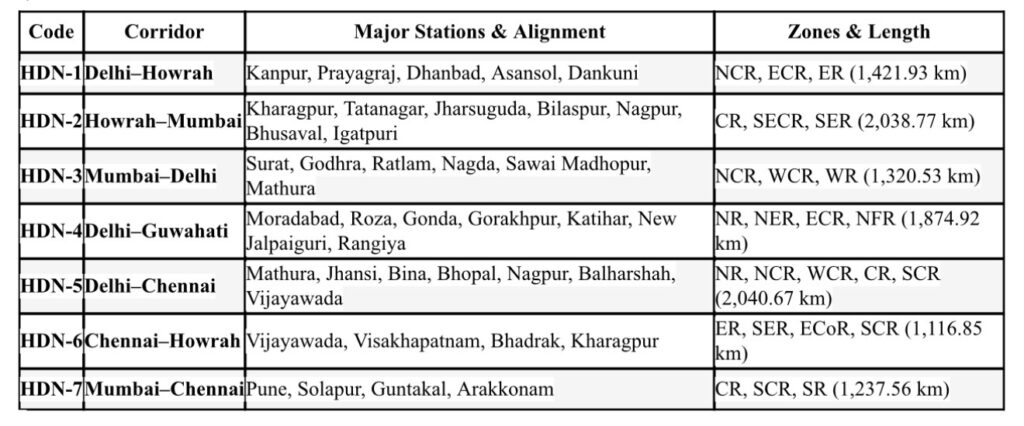
Credit: https://en.wikipedia.org/wiki/High_Density_Network_(Indian_Railways
This is the backbone of railway investment. When officers who have worked as DRMs move into planning, they will make sound decisions with a better understanding of political pressures and will also give sound advice to the Minister and the CRB. The seven HDN routes above have today been split into smaller railways, with just as many interchanges on the lines of octroi checkpoints. If the railways want to increase the average speed of freight movement, there is no option other than bringing these zones back to their earlier scale.
But where will the officers who can carry this thinking forward come from? We believe that officers who have emerged after working as DRMs can show you this. Now the government must think about how to view this from a broader perspective.