

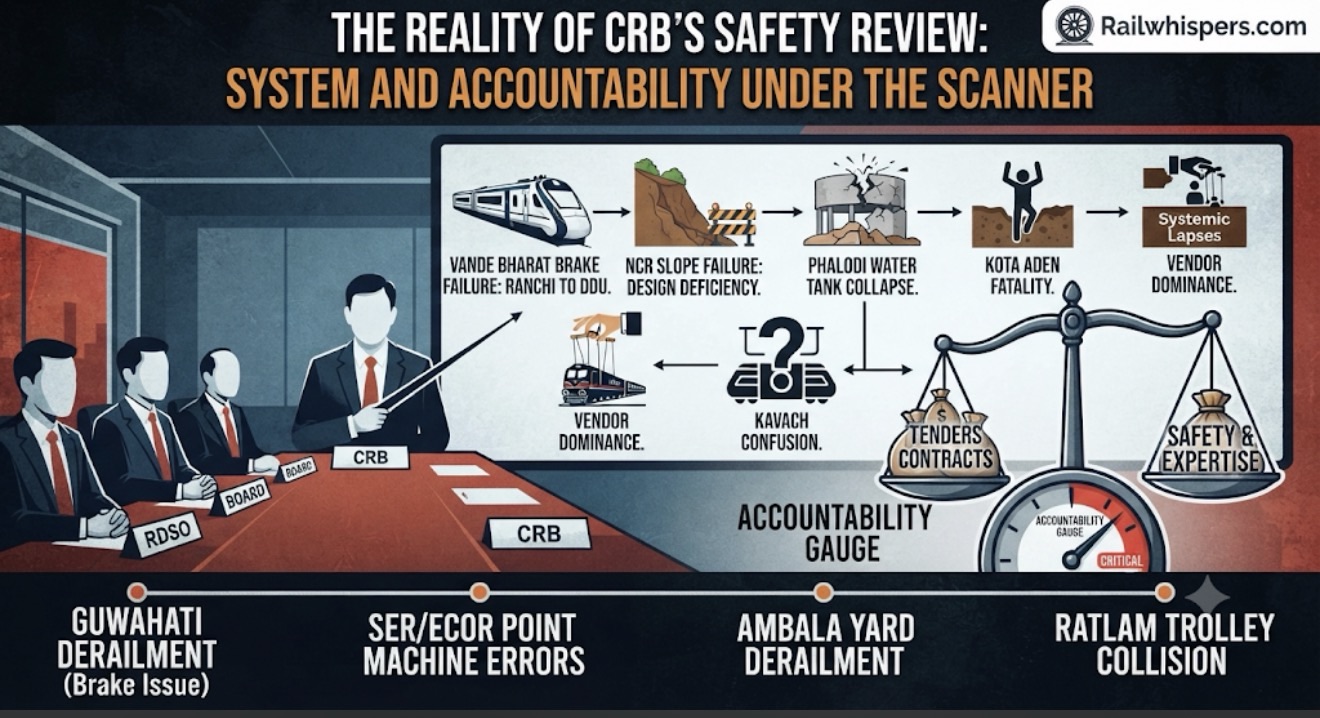
The Reality of CRB’s Safety Review: System and Accountability Under the Scanner
The roughly six-hour marathon safety review meeting chaired by the CRB made several things clear. If the CRB himself does not ask questions, indeed almost nobody is watching anything across most places.
RDSO officials sat tight-lipped on how brakes would fail to apply if a Vande Bharat train were connected to a locomotive via a single pipe. This discussion was in the context of an empty Vande Bharat train that ran without brakes from Ranchi to DDU. On one point, DRM Ranchi expressed disagreement with the CRB and Board officials. The CRB immediately realized that Board and RDSO officials were examining the matter superficially—whereas DRM Ranchi had presented his point after driving the train himself.
The situation of the Guwahati derailment caused by brake failure was no different from the Vande Bharat running without brakes. The CRB quickly caught on that RDSO had not applied its mind while clearing the design. Meanwhile, the slope failure in NCR—which a contractor’s staff spotted and stopped traffic for—was also discussed. Design failure emerged as the cause here as well. In addition, the recent collapse of a 2.5-lakh-litre capacity water tank in Phalodi, Rajasthan, which was not very old, was also attributed to a design deficiency.
It has become clear that lapses on a massive scale are occurring in rapidly progressing construction works, and these are not routine design failures like the false ceiling at Cherlapalli. A worrying aspect is also that just as an ADEN died after getting buried under soil in Kota division, a similar sequence of events unfolded in NCR a few months later.
MOBD, DG/Safety, and the CRB had to speak on the NFR brake failure about how all departments together could commit such basic errors. A train went into a block section without brakes; the station shunting staff, C&W, traction operation, and guard—all lapsed simultaneously.
MOBD emphasized training, but the entire Board remained silent on the questionable role of Gati Shakti Vishwavidyalaya in this whole episode. After today’s meeting, several Level 15 and 16 officers confirmed that the incidents of trains running without brakes in NFR, SER, and ECR cannot be viewed in isolation from the derailments caused by wrong wiring of point machines in SER and ECoR. This is happening due to a large-scale loss of control over the system. Today, railway vendors have a much stronger grip over the railway system than railway officers do!
All these incidents indicate that the railway system has become hollow from within. Career success is being measured by awarding more and more tenders rather than by commitment to the railway system or domain expertise. Today, it also became clear that RDSO and Railway Board officials will not visit an accident site without direct instructions from the CRB.
We have written many times that if the Minister takes a short viva of officials posted in RDSO and the Board, he and the Prime Minister would come to know how their officers travel around the world and merely echo their approval, while their focus remains confined to their own self-interests. Among the general public, the political leadership itself is being held responsible for the pathetic and deteriorating condition of the railways. They will have to remember that officials of the All India Delhi Service (#AIDS) and the Khan Market Gang (KMG) are having a good time—not a hair on their heads has been harmed, nor will it be.
Another revelation during the discussion was that what IRISET’s COE is doing on ‘Kavach’, which is being built at a cost of lakhs of crores of rupees, is unknown to its DG, as well as to RDSO and the ED. After all, who knows what?
Today, divisions are expected to do the work of RDSO as well. Why? Is this not a failure of the Railway Board? Is this not a failure of the Minister? Seeing the face of the railways that emerged today, several officers remarked that never before had railway engineers appeared so helpless and bewildered. This is the report card of the political leadership. Progress of the railways cannot be achieved merely by floating tenders and installing expensive equipment.
Member Infrastructure asked NWR who permitted the installation of a 2.5-lakh-litre capacity water tank in Phalodi when the water requirement there is less than 50,000 litres. The entire Board could not determine how a train could enter a block section with the brake angle cocks closed; and why the sheet pile design in NCR was such that a 10-metre slope failed and shut down the main line for hours—at a time when Chhath traffic was moving across the entire country. Neither was any lesson learned from the Kota division accident, nor did the engineering department deploy a watchman there. Meanwhile, in Ambala yard, an engine and five wagons derailed after a wheel hit a CMS crossing, while in Ratlam, two trackmen lost their lives when a push trolley was hit.
Soon, we will publish a special analysis on this disintegration of the railways. Please stay tuned!