

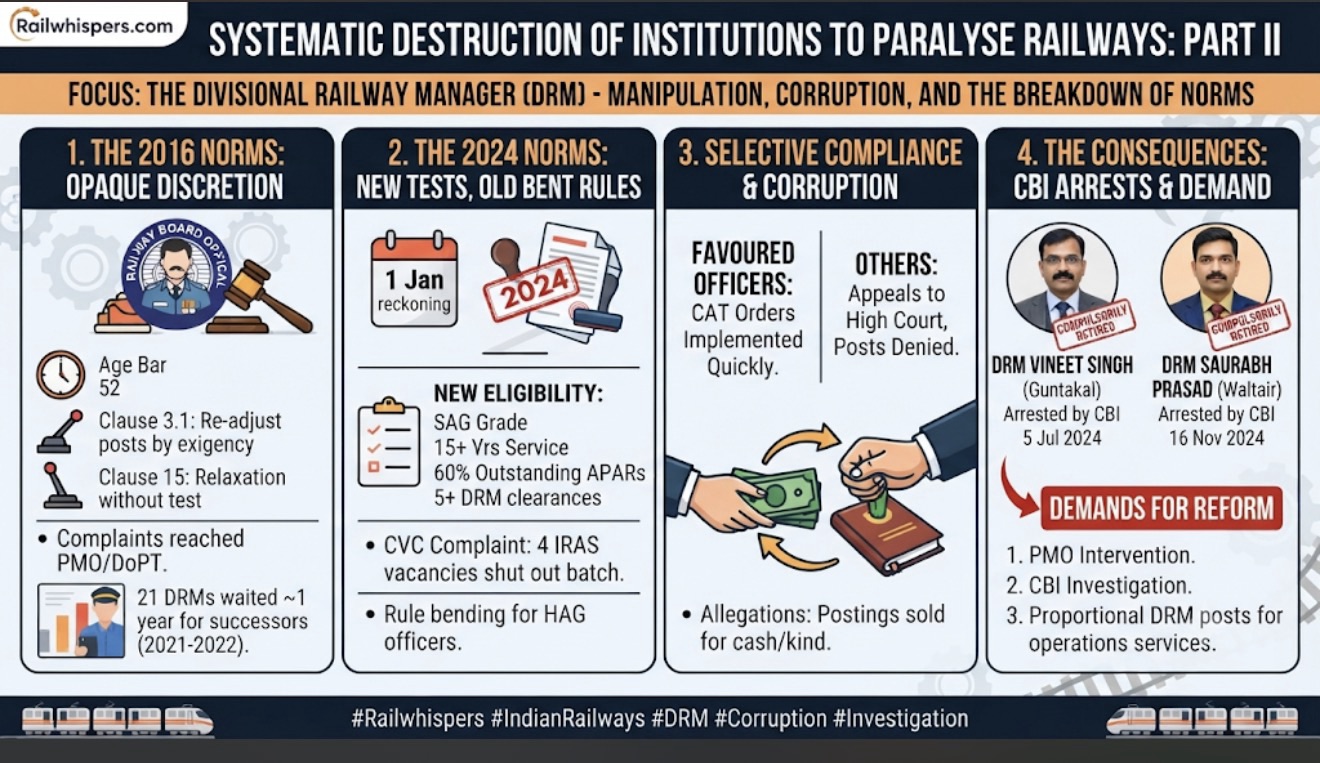
Systematic Destruction of Institutions to Paralyse Railways: Part II
#IndianRailways is one of the few Government departments whose work is operations. It runs about 25,000 trains a day, and in 2025-26 it carried 741 crore passengers and 1,670 million tonnes of freight, on the Ministry’s own figures.
Three institutions have carried that work: the Railway Board at the apex, the General Manager at the zone, and the Divisional Railway Manager (DRM) at the division. In this publication’s assessment, ill-conceived policy changes and partisan postings made for a few undeserving officers have damaged all three in the past few years. Later parts of this series will deal with the Board and the General Manager. This part deals with the DRM, the head of the field unit that runs the trains and maintains the assets.
The 2016 norms gave the Board a discretion with no test attached
Over the past decade, complaints of ad hoc and opaque DRM postings reached several high offices, the Prime Minister’s Office (#PMO) among them, on this publication’s information. The Ministry of Railways then issued guidelines for DRM postings by letter No. E(O)III-2016/PL/02 of 16.08.2016, under pressure from the PMO and the Department of Personnel and Training (#DoPT), on the same information. The Secretary, DoPT, sat on the shortlisting committee that those guidelines set up.
The 2016 norms kept the age bar of 52 and reckoned it on 1 July. Clause 3.1 let the Chairman, Railway Board, readjust DRM posts among the services “depending upon exigencies”, with the Minister’s approval. Clause 15 let the competent authority relax any condition “in a suitable case”, after recording reasons. Neither clause set a test for the use of that power.
T.R.V.S. Ramesh asked about both clauses in Lok Sabha Starred Question No. 125, answered on 27.11.2019 (reply with the 2016 guidelines appended, “Guidelines”). The Minister replied that exigencies cannot be anticipated, and that the principles for the discretion therefore could not be defined. He added that no relaxation had been granted under clause 15 since 16.08.2016.
Postings that waited a year
The 2016 norms worked for about five years. After that, on this publication’s information, officers in the Railway Board began to delay DRM orders to benefit particular officers. On the same information, the tenure of 21 DRMs posted by the order of 16.11.2019 ran out in November 2021, and their successors were posted only on 07.10.2022. IndianMandarins reported that day that 20 officers had been posted as DRM after a wait of about a year.
Many capable and eligible officers lost their chance of a DRM posting through that delay, on this publication’s information. The same information records other DRM orders held back to suit favoured officers.
The 2024 norms changed the dates and the tests
The Board revised the norms by letter No. E(O)III-2024/PL/04 of 03.09.2024 (“DRM NORMS”). The age bar stays at 52. The date for reckoning it moved from 1 July to 1 January, and the shortlist year became the calendar year.
The change of date did not by itself shut anyone out in the year of transition. Paragraph 16 kept eligible, for 2024, every officer who was under 52 on 01.07.2023 and had crossed 52 by 01.01.2024. Two other changes decide who now enters the zone of consideration.
The first is the eligibility test in paragraph 6, which replaced the test of 2016. An officer must now meet four conditions on 1 January:
- Be working in the Senior Administrative Grade.
- Have at least 15 years in the Railways or Railway PSUs.
- Have at least 60 per cent of all APARs of the career graded Outstanding.
- Have at least five DRM clearances in the last ten APARs.
The 2016 test asked for two Outstanding gradings in five years and two or three clearances. The new test reads the whole career, so it changes who enters the zone.
The second is the way vacancies are counted. The Central Vigilance Commission registered a complaint on 3 November 2026 under No. 172868/2026 (19 November 2026, “CVC Registers Formal Complaint Against Irregularities in DRM Empanelment; Board Already Admitted Lapses Before CAT”). The complaint states that four IRAS vacancies due in 2025 were counted against the 2024 panel, and that the 1 January age date then shut the eligible 1998 IRAS batch out for good. Insiders told this publication that officers who crossed 52 on 31 October are also being empanelled (20 November 2026, “Editorial: DRM Postings, Rule Bending, and Railway Reforms”).
The split of DRM posts has no stated basis
Both sets of norms say that services directly involved in train operations will hold more DRM posts. The 68 posts are split as IRSE 14, IRTS 14, IRSME 14, IRSEE 10, IRSSE 6, IRAS 4, IRSS 4 and IRPS 2. On that classification, the five services in train operations hold 58 posts and the three that are not hold 10.
Within the 58, Electrical holds 10 and Signal and Telecommunication 6, against 14 each for Civil, Mechanical and Traffic. Neither set of norms ties the split to the cadre strength of a service or gives any other basis for it. The 2024 revision changed the dates and the tests, and left the split exactly as it stood in 2016.
Court orders, complied with selectively
The policy changes and the delayed orders did not stay within one panel. Each carried into the panels after it, and aggrieved officers went to the Central Administrative Tribunal. The Board’s own information note on the 2025 shortlist lists an officer added to the 2024 shortlist under CAT orders. The CVC complaint states that the Board has admitted the procedural lapses before CAT.
The Ministry did not comply with these orders uniformly, according to this publication’s information. Where an aggrieved officer paid in cash or kind, this publication is informed, the CAT order was implemented. Where an officer did not pay, the same information says, the Railways appealed to the High Court and the case ran for years while the officer was promoted to HAG. The Railways then pleaded that a HAG officer cannot be posted as DRM, a bar that paragraph 13(a) of the 2024 norms does state.
The same bar is now being bent the other way. This publication reported on 20 November 2026 (“Editorial: DRM Postings, Rule Bending, and Railway Reforms”) that officers believed to be in HAG are getting rules changed to secure DRM posts. It fits a saying often heard about the Ministry of Railways: “You show me the face, I will show you the rule.”
Two DRMs trapped by the CBI
The CBI arrested Vineet Singh, DRM Guntakal, on 5 July 2024, on its charge of taking bribes in the award of contracts. It arrested Saurabh Prasad, DRM Waltair, on 16 November 2024, on its charge of accepting a bribe of Rs 25 lakh. The Railways compulsorily retired both officers in the public interest under Rule 1802(a) of the Indian Railway Establishment Code, Volume II (24 March 2026, “Late than never: Railway takes strict action against non-performing & corrupt officers; compulsorily retired six officers”). On 7 September 2026 the CBI registered a disproportionate assets case of Rs 2.19 crore against Saurabh Prasad (11 September 2026, “CBI Books Sacked Former DRM/VSKP Saurabh Prasad in ₹2.19 Crore DA Case”).
Officers who become DRM through manipulation and payment go on to practise corruption in the post, on this publication’s information. They recover what they paid to those in the Ministry of Railways who sold the posting, with a premium, the same information says. Allegations of corruption against DRMs are rising, on the same information.
Both officers belong to IRSME, the service from which the present On Contract-Chairman & CEO, Railway Board, came. Both were posted as DRM before he took office on 1 September 2024: Vineet Singh to Sambalpur by the order of 07.10.2022 and to Guntakal in January 2024, and Saurabh Prasad to Waltair in July 2023.
What is asked
When the head of a division is posted through manipulation, corruption spreads down the division, as this publication reports from the field regularly. Three things are asked:
- The Prime Minister’s Office should intervene in DRM postings.
- The CBI should investigate the institutionalised corruption in DRM postings.
- The Board should give DRM posts only to the services in train operations, in proportion to their cadre strength. Contd.