

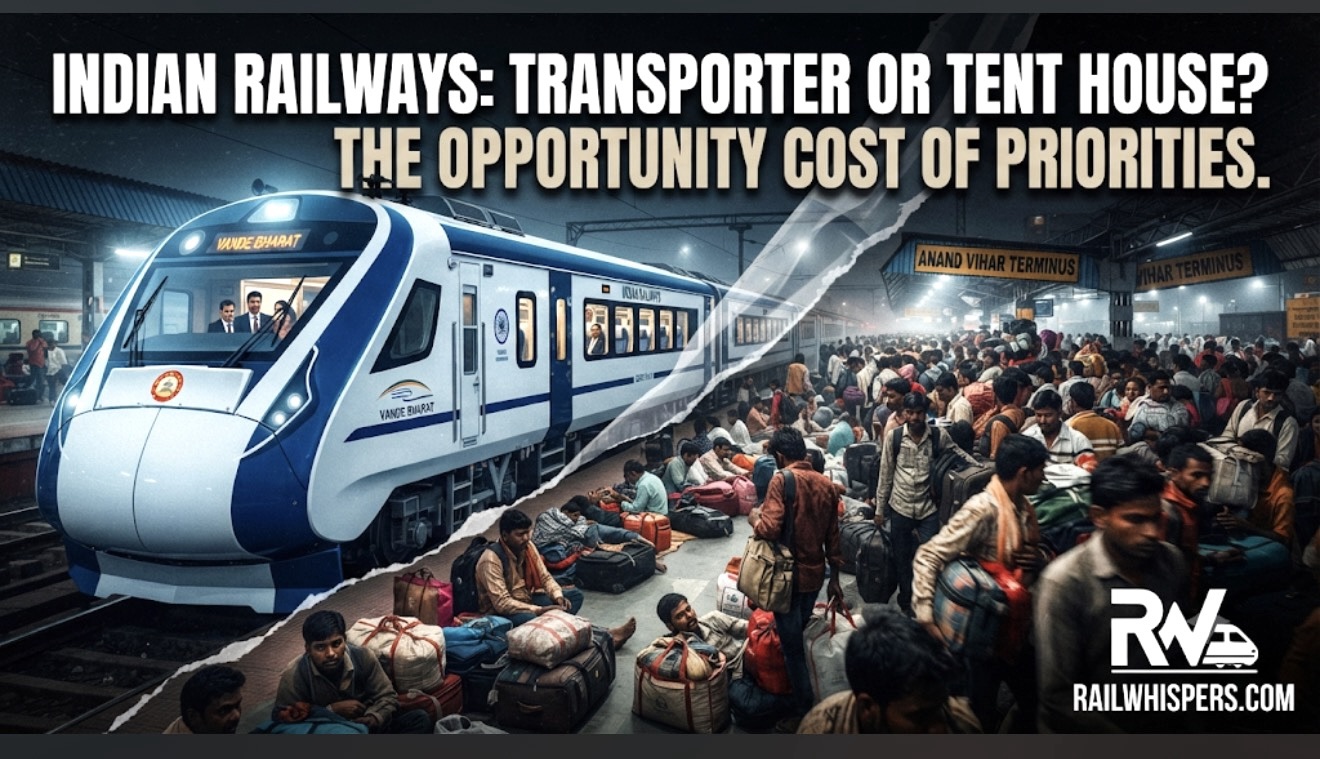
Indian Railways is not a Tent House
The images from Anand Vihar Terminus this week carry a plain message. Indian Railways appears to have forgotten that it is a transporter, not a tent house. A #transporter with its long record of handling festival traffic should have anticipated the surge. To assume that passengers can simply be parked in a ‘holding area’ is to abdicate the core job.
The context makes the failure harder to excuse. The Delhi Division already lost its Divisional Railway Manager over crowd mismanagement. What has changed since? For two months the visible effort went into the Swachchhata drive and Sajja-type activities that have no bearing on mobility. A division cannot prepare for a festival rush while its attention sits elsewhere.
The deeper pattern is one of misplaced priority. For several years the thrust has been to rebuild even small stations with negligible footfall into expanses of concrete, granite flooring, lifts, escalators and foot-over-bridges. This column has argued repeatedly that the Railway must stay focused on core mobility and safety. Spending shows up most where it contributes least to moving people.
Rolling stock tells the same story. Before the 2024 general election we warned that a shortage of general-service coaches would become the Railway’s nemesis. Having read the electorate’s anger in that election, the Railway then ordered 5,000 GS coaches in a hurry. At the same time it ordered the premature scrapping of serviceable ICF coaches. The mechanical department’s whole energy has gone into premium Vande Bharat trains.
A point is forgotten here. Any shell can carry any grade of furnishing. A standard ICF or LHB coach can be fitted out to a five-star finish. Vande Bharat sets are expensive to buy and demand a dedicated maintenance depot costing at least ₹500 to ₹1500 crore. The question is not whether such trains have a place. It is whether their place justifies the opportunity cost in basic capacity.
The real failure is managerial
Network planning, network management, rolling-stock planning and rolling-stock maintenance have all been handled poorly by the Railway bureaucracy. Additional lines and yards were genuinely needed, but only to hold the existing rate of growth, not to deliver the step change that sound planning could have produced. The result reaches the passenger as desperation: road transport is costly even for short distances, so the load on the Railway runs far above comfort, and anger follows.
The political leadership now has to examine its own choices in selecting the people who run these organisations. The government needs domain experts, people willing to place every option on the table, including the uncomfortable ones. Decision-makers in the political executive should see the full set of choices rather than be taken by surprise. After spending close to ₹20 lakh crore in Indian Railways, they are owed an answer to one question: why does Anand Vihar look the way it does today?
1. The Core Arguments of the Debate
The Case for Vande Bharat (Modernization & Speed):
- Aspirational Growth: Proponents argue that India’s expanding middle class and economic corridors require world-class infrastructure. Vande Bharat offers faster acceleration, reduced travel times (by up to 30–45%), modern safety features, and a clean, premium travel experience.
- Global Benchmarks: It serves as a flagship symbol of “Make in India” manufacturing capability and technological leapfrogging.
The Case for General Capacity (The Equity & Volume Argument):
- The Overwhelming Majority: The vast majority of non-suburban rail users rely on non-AC sleeper and general (unreserved) compartments. Critics and transport analysts point out that focusing heavily on AC chair cars and sleeper trainsets risks sidelining nearly 90% of regular passengers who depend on affordable rail transport.
- Carrying Capacity Crunch: A standard LHB or conventional train handles higher aggregate numbers of passengers per rake compared to specialized chair-car trainsets, and general coaches remain severely over-burdened during peak festival rushes (as seen in terminal overcrowding crises).
2. The Opportunity Cost Dilemma
The debate isn’t necessarily about whether high-speed semi-trainsets have a place on the network, but rather about opportunity cost:
- Capital Intensity: Vande Bharat rakes and their specialized maintenance infrastructure (requiring dedicated depots running into hundreds of crores) demand massive capital allocation.
- Network Saturation: India’s railway network is heavily congested. Running mixed-speed traffic—where premium high-speed trainsets share tracks with slower freight and overcrowded passenger trains—often creates bottlenecks, leading to sectional capacity losses when faster trains must overtake slower ones.
Ultimately, transport economists and planners argue that while branding and speed are vital for economic corridors, the fundamental yardstick of Indian Railways must remain its ability to safely, comfortably, and adequately transport the massive volume of common citizens who form its core lifeline.