

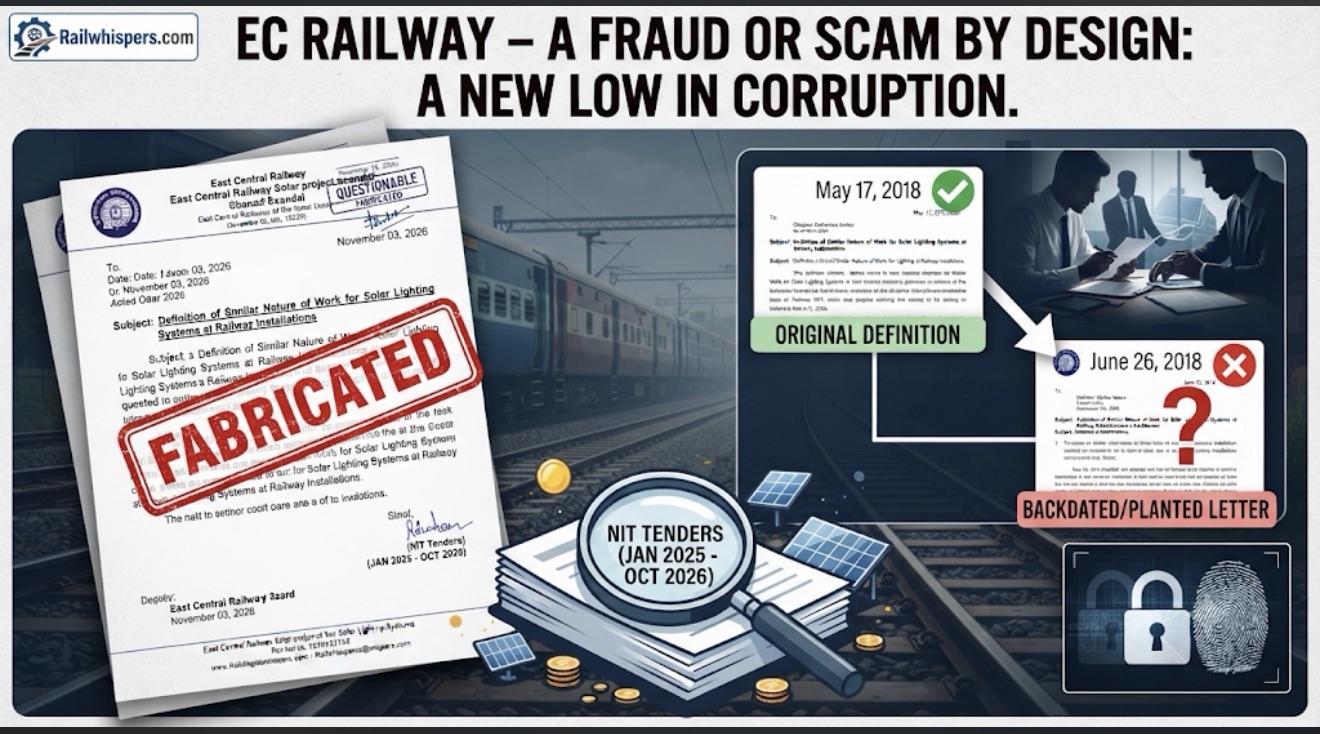
ECRailway: A Fraud or Forgery by Design: A New Low in Corruption
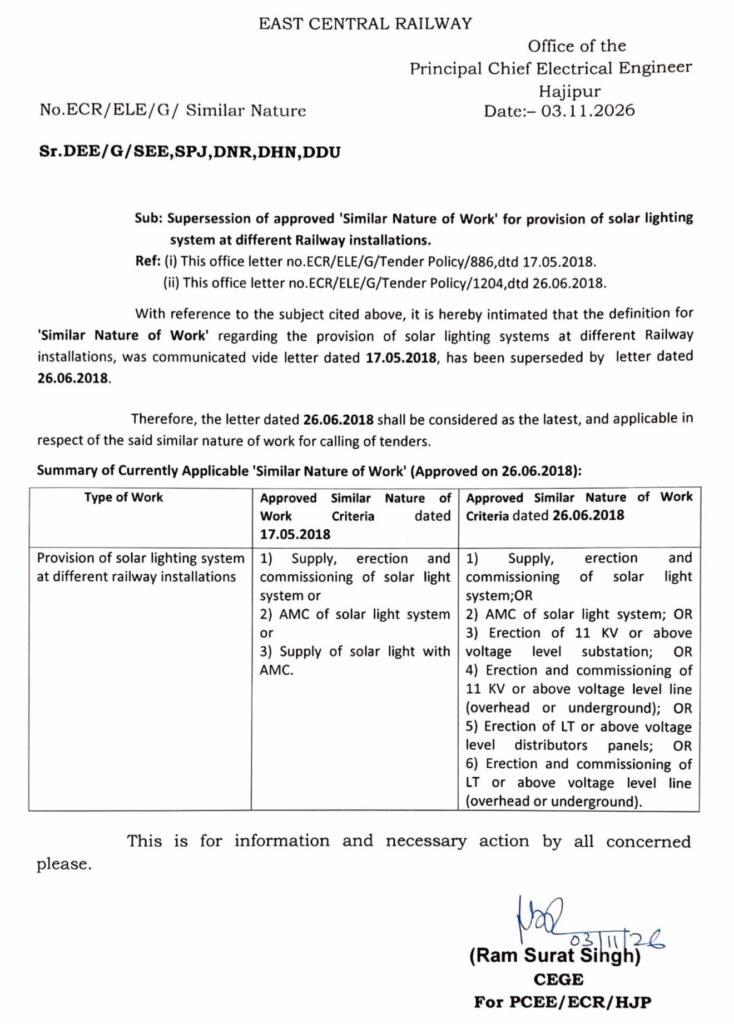
The office of the Principal Chief Electrical Engineer, Hajipur, East Central Railway, suddenly woke from its slumber and issued a letter on November 3, 2026, stating that the definition of “similar nature of work”—regarding projects such as the provision of solar lighting systems at various railway installations, communicated via a letter dated May 17, 2018—had been supersed by a letter dated June 26, 2018. Consequently, the letter dated June 26, 2018, was declared to be the latest and applicable one.
On a plain reading of the letter dated November 3, 2026, any person of common prudence and sense would be astonished: June 26, 2018, chronologically follows May 17, 2018, so anything issued on the former date is obviously the later one. What, then, was the pressing need to issue this clarification now?
While we refrain from commenting on the poor language of the letter—which bears the signature of a Senior Administrative Grade (SAG) officer of East Central Railway whose English grammar falls below the standard of a 6th-grade student—we must seriously question the timing and intent behind its issuance.
Why did this letter have to be released at this juncture? Over approximately the last two years—from January 2025 to October 2026—three Notice Inviting Tenders (NITs) by ECR’s Danapur Division for solar lighting systems explicitly defined “similar nature of work” in accordance with the letter dated May 17, 2018. In two of these cases, the works have already been awarded, while for the third, the tender has been invited.
If a letter dated June 26, 2018, truly existed, why was the division adhering to the May 17, 2018 definition all along? Reliable sources allege that no such letter dated June 26, 2018, ever existed and that it has been fabricated with mala fide intent to favour a particular contractor who shares close religious ties with the Senior DEE (General), Danapur.
For more than eight years, all tenders have been floated online, and every NIT has been in the public domain. Yet, until now, no contractor, or agency, or even the Vigilance Department has raised any objection. It is virtually impossible to accept the narrative currently being propagated by the PCEE/ECR office.
Insiders and other quarters allege that the letter dated June 26, 2018, is a backdated forgery planted to manipulate the system and favour a specific bidder whose roots trace back to South East Central Railway (#SECR), from where the current ECR-PCEE was transferred following a major train accident.
While these may be mere coincidences, institutional collusion cannot be ruled out, according to a senior official. The letter dated June 26, 2018, must be subjected to a thorough forensic examination. One must ask: Why was a new definition of “similar nature of work” not issued with a current date? Why was a backdated letter suddenly brought into play?
These questions raise serious doubts regarding the integrity and intent of the issuing authority. This appears to be a deliberate attempt either to issue a corrigendum to the “similar nature of work” clause of an active tender worth over ₹7 crore, or to get the tender cancelled entirely. Although arguments of ensuring wider participation are being touted, administrative actions often tell a different story.
As a matter of national policy and energy security, the Government of India strongly advocates for diversified energy sources, prioritizing solar energy above all. The government extends subsidies and numerous concessions to firms in the solar power sector to protect and promote industry players, affording them preferential treatment.
However, the PCEE office of ECR seems to be operating in reverse gear. Instead of safeguarding stakeholders in this specialized sector, it is pitting them against firms possessing broader electrical contracting credentials and vastly superior resources.
It is impossible for dedicated solar sector firms to match the aggressively low prices quoted by general electrical contractors, who routinely bid 30% to 40% below estimates. Handling multiple large-scale projects allows general contractors to cross-subsidize their investments—a luxury unavailable to specialized solar power players. An old letter of questionable authenticity has thus been conveniently unearthed simply to elbow out solar sector specialists and favour a contractor close to the Sr.DEE (Gen), Danapur.
Why was this same policy not applied to rooftop solar panel installations? Why are those tenders not open to all? Furthermore, will firms with experience exclusively in solar lighting be permitted to undertake general electrical works, as supposedly prescribed in the dubious letter of June 26, 2018?
The letter dated November 3, 2026, raises far more questions and doubts than it clarifies. Its timing and intent warrant immediate scrutiny. This directive should be frozen until a comprehensive forensic investigation into the June 26, 2018 letter is concluded; until then, the existing definition of “similar nature of work” as originally published in the NITs must remain in force.
The Chairman of the Railway Board and the General Manager of East Central Railway should personally demand an explanation for the issuance of such an absurd directive, which makes a mockery of due process and turns the entire Indian Railways into a laughingstock.