

Office Order 58 of 2016 has finally caught up with Indian Railways
First in the Supreme Court, when Dr. Ambedkar was forgotten. Then on the Trivandrum Rajdhani, when coach B-1 caught fire.
Two events—Nine days apart
- The first, on 8 May, when a two-judges bench of Justice Dipankar Datta and Justice Satish Chandra Sharma dismissed Civil Appeal No. 4652 of 2024, 2026 INSC 464, and held that #IndianRailways is a #consumer of electricity, not a deemed distribution licensee. The Railways must now pay cross-subsidy surcharge and additional surcharge on every unit it has purchased through open access, retrospectively, for the better part of a decade.
- The second, on 17 May at 5.15 am, when coach B-1 of Train 12431, the Trivandrum–Nizamuddin Rajdhani, caught fire between Luni Richha and Vikramgarh Alot stations in Ratlam district. All 68 passengers in B-1 were evacuated. No passenger died. The coach itself was gutted, the fire spread to the adjoining luggage-cum-guard van, and a relief vehicle rushing to the site overturned in a roadside gorge, injuring more than five railway staff. A nationwide audit of fire-related systems has been ordered.
A nationwide audit. That phrase is the tell
Let me state plainly what nobody in #RailBhavan is saying: “these are not two separate failures. They are the same failure, surfacing at two different points on the network. And the failure is not on the tracks. It is in the cadre.”
- One verdict the #Constitution was written to prevent.
- One fire the 2016 cadre churn was rearranged to allow.
- Two failures, one building.
The Constitution had a clause for this. The brief did not
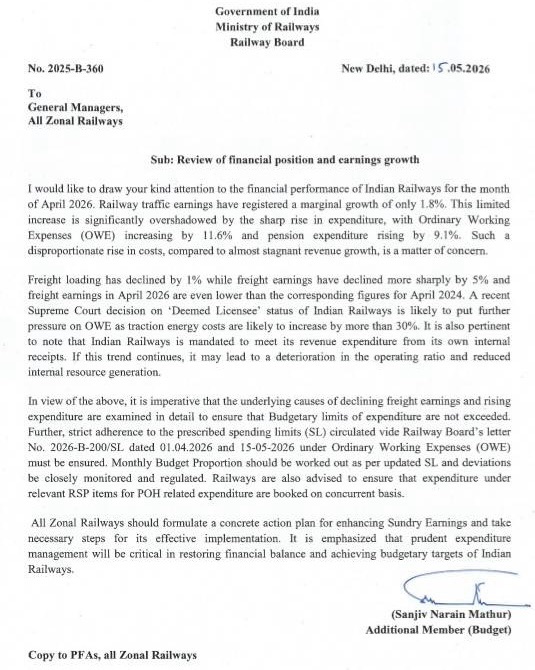
The Additional Member (Budget)’s letter of 15 May 2026 to all General Managers concedes the financial damage on Government of India letterhead: “by Indian Railways’ own internal estimate, traction energy costs are expected to rise by more than thirty per cent.” Put that on the network’s existing draw of upward of 33 billion units a year and the absolute number runs into several thousand crore on the annual run-rate alone, before any retrospective settlement. #Railwhispers has separately estimated accumulated payables at ₹20,000 to ₹25,000 crore and the annual increase at ₹2,000 to ₹3,000 crore — figures the discoms’ SC-mandated statements will, in the months ahead, either confirm or push higher. Either way, an operating ratio already hovering near 100 takes the punch.
That is the size of the loss. The more interesting question is how it was lost?
Constitutional lawyers use a phrase: legal scaffolding. Indian Railways’ case rested on three statutory layers, in descending order of authority:
- The Constitution. Articles 285 to 289 set the fiscal architecture between Union and States. Article 287, the one that matters here, expressly forbids any State from imposing a tax on electricity consumed by the Government of India in the construction, maintenance or operation of a railway. It is not a footnote. It is a clause Dr Ambedkar drafted to anticipate precisely the kind of dispute that reached the Supreme Court on 8 May.
- The Railways Act, 1989. Section 11 confers on Railways the #statutory power to build and operate its own electrical infrastructure for traction. This is the authority on which the deemed-licensee claim was hung.
- The Electricity Act, 2003. Indian Railways’ claim rested on the third proviso to Section 14, read with the contention that the Railways is the ‘Appropriate Government’ for matters relating to railways. The Supreme Court accepted the Appropriate-Government limb only for limited purposes (paragraph 42 of the judgment). Section 173 of the same Act, separately, provides expressly that nothing in the Electricity Act shall have effect to the extent it is inconsistent with the Railways Act, 1989, a non-obstante clause whose force, on this record, was insufficiently pressed.
Dr Ambedkar moved the provision on 9 September 1949, in precisely this kind of context. The cross-subsidy surcharge is fixed by State electricity regulators, varies State by State, and is levied on every unit Railways buys to run its trains. Whether that makes it a ‘tax imposed by a State’ within the meaning of Article 287 is a question the Court was never asked to consider, because the Railways’ brief never asked it.
This is not hindsight. The protection sits in the Constitution precisely to anticipate this category of dispute. Ambedkar said so on the floor of the Constituent Assembly. Any senior officer who has actually run a traction substation, and any senior counsel briefed properly, would have spotted it.
The brief that reached the Supreme Court did not. During the hearings, the respondents systematically dismantled the legal scaffolding while the IR and #REMCL teams stood as near-mute spectators. No one had done the homework, and the institutional truth is that there are no consequences in Indian Railways for losing a case. The Railways had gone to the Court to challenge the APTEL order that rejected its deemed-licensee status. The grounds on which the claim had been thrown out were on the record. The grounds on which it might still have been resurrected — Article 287 most prominently — were on the record too. The bosses, meanwhile, were busier polishing their CVs than doing the unglamorous work of constitutional research.
I am told the matter, at the Board end, was effectively handled at Section Officer level, with #REMCL providing operational inputs and no senior strategist plugged in. By the time #APTEL set aside the 2015 #CERC order in February 2024, no one had bothered to change gears or the line of argument. Ten years of litigation. Two forums. One Constitution Bench-worthy argument that was never made.
Coach B-1 was the symptom. OO 58 was the cause
To see why the Rajdhani fire is not an isolated coach-level event, you have to go back to Office Order No. 58 of 2016, signed by the Secretary, Railway Board, on 3 August 2016.
That order moved diesel locomotives, their sheds, crew, running rooms and the entire fuel-management function from Member Mechanical to Member Electrical, who was simultaneously redesignated Member Traction. In the opposite direction, EMU/MEMU stock, all trainsets including Vande Bharat, and the electrical maintenance of all coaching stock were moved from Member Electrical to Member Mechanical, redesignated Member Rolling Stock.
Read that again. A diesel shed — mechanical to its bones — now reports administratively to an electrical hierarchy. A Vande Bharat trainset — electrical end to end — now reports administratively to a mechanical hierarchy. Paragraph 3 of the same order then says posting and transfer of officers will continue to be done by the existing cadre-controlling Member, in mere consultation with the Member in administrative charge. Paragraph 4 says the APAR is countersigned by the cadre-controlling PHOD or Board Member. The asset moved one way. The engineers who run it did not. The Member who can transfer an officer is different from the Member who is supposed to direct his work. Five months earlier, Office Order No. 11 of 2016 had moved Signal and Telecommunication out of Member Electrical and placed it under Member Engineering, who is, in essence, a civil engineer. By August 2016, signalling sat under civil, trainsets under mechanical, and diesel under electrical. Nobody in Rail Bhavan could draw the organisation chart on one page anymore.
This is not transformation. It is administrative musical chairs played by people who did not have to ride those trains.
The other consequence was structural. For several years after the churn, recruitment of young engineering officers through UPSC’s Engineering Services Examination was choked. The cadre logic had collapsed and HR did not know what to feed into the funnel. It took a string of accidents — Balasore in June 2023, with close to three hundred dead and more than a thousand injured, was the worst of them — for the tap to be reopened. By then a generation of officers had been lost.
The fires, the derailments, the audits announced after the fact: “these are the bill the system is now paying.”
Coach B-1, AC three-tier, on a fully electrified corridor, on a flagship train. Read the maintenance trail. Ask whose engineers inspected what, reporting to whom, against whose checklist. The answer lies in the cadre confusion seeded by OO 58, not in fire-detection systems alone. And this corridor has seen Rajdhani fires before: “pantry car in April 2011 near the same set of stations, again in June 2020. Each time an audit was ordered. Each time the audit cleared the system. We are now on audit number three.”
The win was strategic. The cadre to defend it no longer exists
It is worth pausing on the achievement now being put at risk.
In 2024-25, Indian Railways burnt less diesel than it did in 1980-81, even as freight tonnage grew more than eightfold and passenger-kilometres roughly fivefold over those four decades. In this government’s tenure, diesel consumption fell from 286 crore litres in 2014-15 to 98 crore litres in 2024-25. The substitution was electricity, drawn from the network’s own traction grid—“Less Diesel than 1980-eight times the freight Indian Railways quite-triumph and the court order that complicates it”.
These are not press-release numbers. They describe one of the most consequential strategic wins of Indian infrastructure: a permanent reduction in this network’s exposure to imported crude. Every litre of diesel Indian Railways did not burn was a litre that did not have to traverse the Strait of Hormuz, did not have to be paid for in foreign exchange, and did not expose Indian freight to oil-price shocks.
The 8 May judgment does not undo that win. It makes it more expensive at the margin, and exposes the financial edge of the network at a moment when it can least absorb the shock. The 17 May fire does not negate the win either. It points to the part of the system that the 2016 reorganisation never properly digested.
The two together do something the Board would prefer the public not see clearly. They tell you that the cadre which delivered electrification cannot, in its current configuration, defend it.
Someone is telling stories. The dates do not back them
In the days since the judgment, a particular story has begun travelling out of Rail Bhavan. That the Prime Minister’s Office wanted this outcome. That the Power Ministry concurs. That the political leadership has, in effect, sanctioned the bill. Some retired officers, speaking in private, have even claimed the verdict was delivered at the PMO’s express prompting — a claim that, leaving aside what it says about respect for the Court, says rather more about the messenger than the message.
This is nonsense, and it is worth saying so plainly.
Set this against the rest of the same fortnight. On 15 May, state-owned oil companies (IOC, BPCL and HPCL) raised retail petrol and diesel by ₹3 a litre, their first hike in four years. On 16 May at The Hague, PM Modi described the present period as a ‘decade of disasters’ and warned that pandemic, wars and an energy crisis could undo the gains of decades and push large populations back into extreme poverty.
Days earlier in Hyderabad, he had asked Indians to brace for austerity — work from home where possible, defer overseas travel, hold back on gold, conserve fuel as an act of patriotism. The Strait of Hormuz is in the news for the wrong reasons. Crude has crossed $120 a barrel. The Philippines has declared a national energy emergency, Japan has released emergency oil reserves, and the International Energy Agency has called this the largest supply disruption in the history of the global oil market.
In that frame, the claim that the very same PMO secretly wanted Indian Railways to absorb a 30% hit on traction energy cost (a cost that flows directly into freight tariff, which flows into the price of cement, fertiliser, foodgrain and coal, which flows into the inflation print) does not survive a moment’s examination. No PMO that has spent eleven years guarding the inflation flank, that has just asked citizens to ration their own fuel as a patriotic duty, signs that off voluntarily. The story is logically incoherent. It is also, frankly, beneath the dignity of those telling it.
The 2014 clarification from the Ministry of Power, issued after consulting the Ministry of Law and Justice, treated Railways as a deemed distribution licensee. The Court read it as administrative opinion. The reading is contestable. What is not contestable is that the clarification existed, and that the Union of India had a position. The story that the political establishment wanted Railways to lose is a face-saver, manufactured in-house to cover an avoidable defeat.
A short list—None of it new
- One. File a review or curative petition that places Article 287 squarely before the Court, briefed by constitutional counsel of the calibre this case always deserved. Move concurrently to amend the Electricity Act with a targeted clause that directly addresses Sections 14, 42 and 173 — not the diffuse 2025 Bill that gave the Court its opening.
- Two. Undo Office Order No. 58 of 2016. Restore the 2015 cadre balance. Match asset to engineer to controlling officer. Stop pretending that signalling, traction, rolling stock and mechanical engineering can be shuffled like portfolios in a Cabinet reshuffle.
- Three. Build a permanent techno-legal unit inside the Board, at Additional Member level, staffed by officers who have actually run substations and depots, and let it own cases of this magnitude. The Section Officer model is over. It was over before APTEL.
- Four. Stop seeding narratives. Investments in this network are at a historic high. The government, the taxpayer and the men and women who put on uniform at four in the morning to run those trains deserve a system that defends those investments — in court and on the track.
The fortnight that just passed was not bad luck. It was a result.
Until that is acknowledged in Rail Bhavan, the next fortnight will look similar.