

WR: Glossy Posters vs. Grim Reality: The Mirage of Indian Railway ‘Progress’
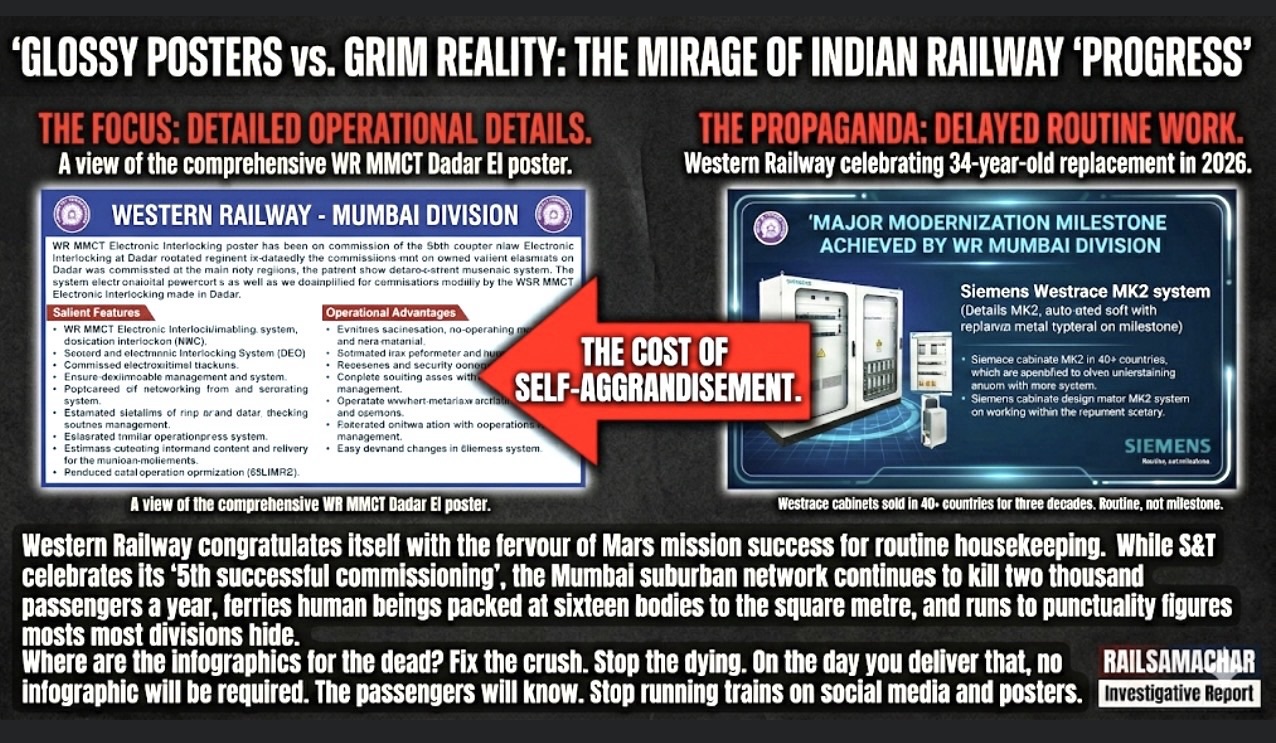
The disconnect between the marketing department of #IndianRailways and the harsh realities on the tracks has never been more stark. While #WesternRailway takes to social media with a self-congratulatory, high-production-value infographic hailing the commissioning of a new Electronic Interlocking (EI) system at Dadar, the actual state of the network remains in a perilous decline.
The Myth of the ‘Milestone’
The infographic touts the transition from a 34-year-old Route Relay Interlocking (#RRI) system to a “state-of-the-art” Siemens Westrace MK2 system as a “Major Modernisation Milestone.” In reality, this is not innovation; it is overdue maintenance. Electronic Interlocking has been the global standard for signal engineering since the 1980s. Celebrating the replacement of 20th-century technology in the year 2026 is akin to celebrating the installation of a standard elevator in a skyscraper that should have had one decades ago.
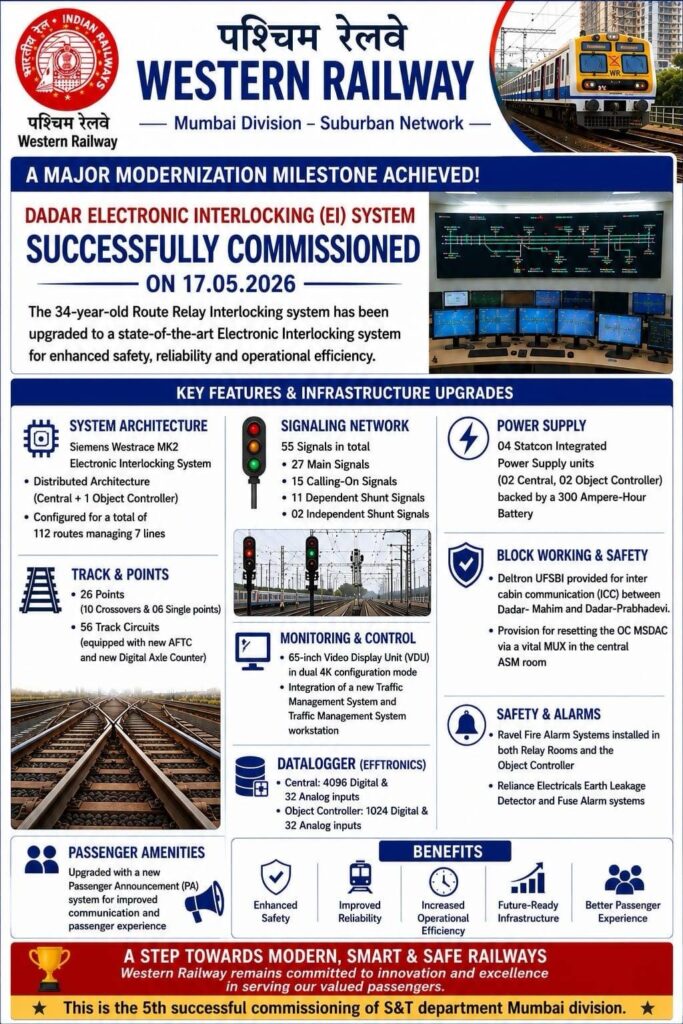
This culture of “babudom”—where routine housekeeping is treated as a heroic feat—serves only to mask institutional stagnation. It is a performative distraction from the systemic failures that continue to plague the network.
The Contrast: Empty Rhetoric vs. Emptying Trains
The absurdity of these promotional posters is laid bare when placed alongside the frequent reality of the tracks.
- The Propaganda: A vibrant poster claiming “Enhanced Safety” and “Improved Reliability.”
- The Reality: The recent derailment of the Ujjayani Express (an empty rake) highlights the precarious nature of operations.
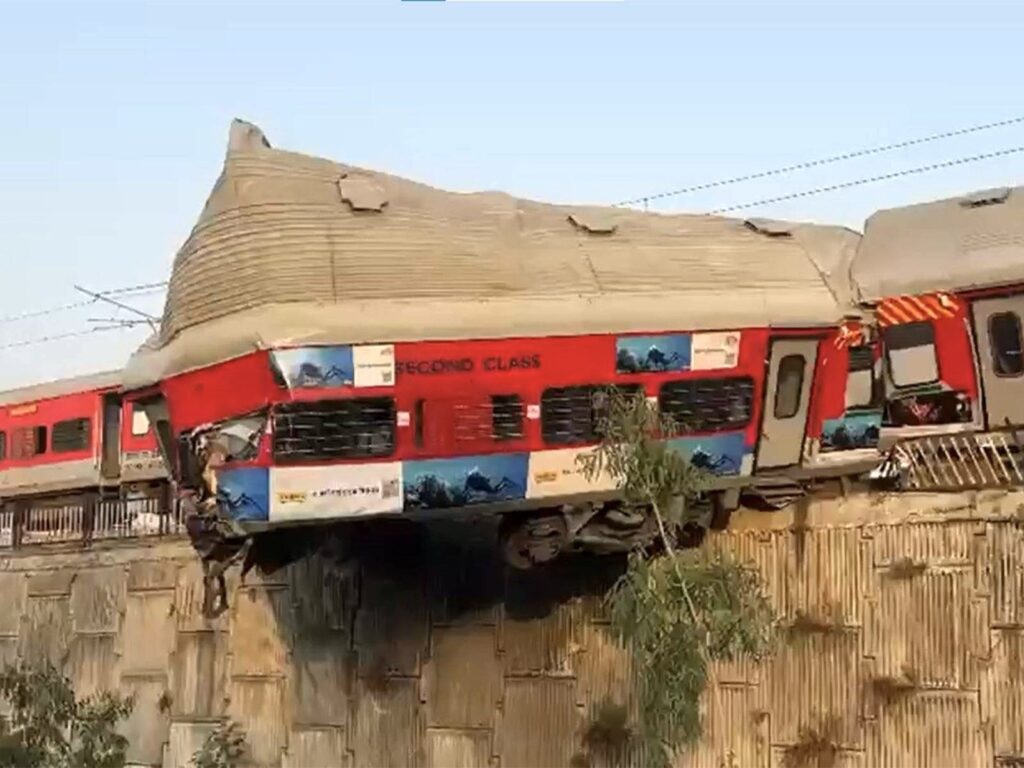
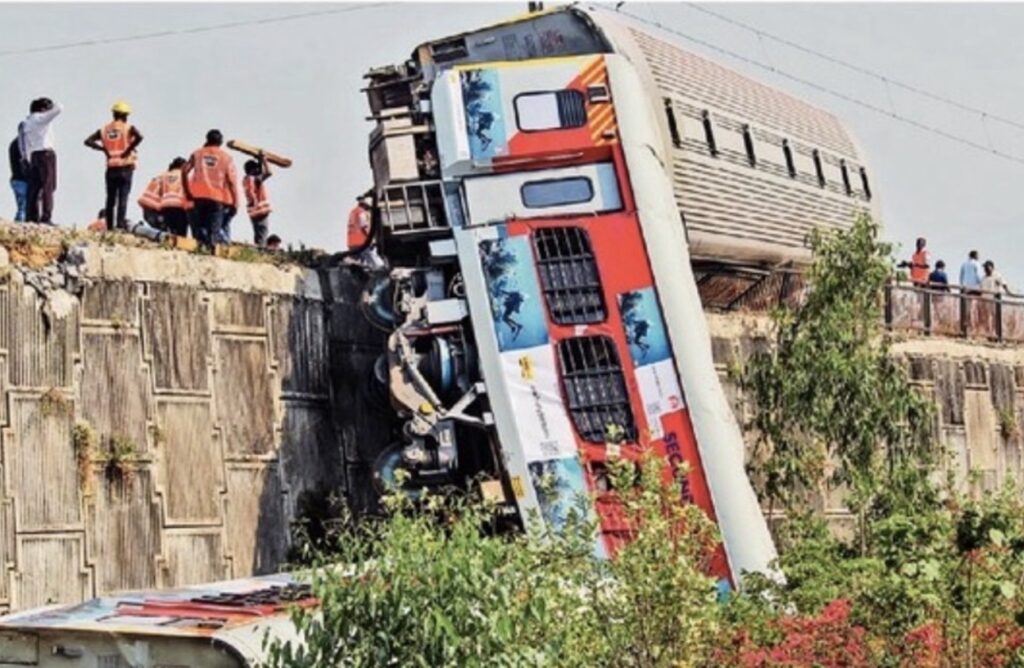
While the Signal & Telecommunications (S&T) department celebrates its “5th successful commissioning” with slick graphic design, the Mumbai suburban network—the lifeline of the metropolitan city—remains a scene of daily tragedy. We see no infographics documenting:
- The thousands of annual passenger fatalities.
- The inhumane “crush load” conditions of 16 people per square metre.
- The consistent lack of punctuality that defines the daily commute.
A Plea for Substance Over Style
The Railway Board’s addiction to self-aggrandisement is a reliable indicator of an organisation that has lost its way. When an entity spends more time managing its image than managing its operations, it is a clear sign that the focus on core #Safety and #Efficiency has evaporated.
The management would do well to remember that passengers do not commute on social media, nor are they comforted by PDFs filled with technical jargon about “vital MUX” and “axle counters” while they cling to the footboards of overcrowded trains.
The mandate for the railways is simple:
- Run the trains on time.
- Stop the preventable deaths.
- Fix the overcrowding crisis.
When the Indian Railways finally delivers these outcomes, they will find that they no longer need to design glossy posters to manufacture applause. The passengers will notice the difference without being told. Until then, these infographics are nothing more than a noisy, headache-inducing distraction from a system that is failing those it is meant to serve.
To move from performative “milestones” to genuine, passenger-centric improvements, the focus must shift from back-end signaling infrastructure—which is a prerequisite for a modern railway, not an achievement—to front-end capacity and safety.
Here are four high-impact, data-backed alternatives that would fundamentally transform the commuter experience in the Mumbai Division:
1. The “Capacity First” Infrastructure Strategy
Instead of celebrating signal upgrades, the Western Railway should prioritize projects that directly alleviate the “crush” factor.
- Decoupling Freight from Commuter Lines: The current network is hamstrung by sharing tracks with freight. By completing dedicated freight corridors (like the WDFC) and ensuring zero freight movement on suburban tracks during peak hours, the system can immediately increase the frequency of local services.
- 15-Car and 20-Car Rakes: The most cost-effective way to increase capacity without laying new tracks is to extend platforms and increase train lengths. Every 15-car rake adds 25% more capacity per train. A systematic, time-bound rollout of 15/20-car rakes across all lines is an actionable metric, not a marketing talking point.
2. Radical Safety Upgrades (The Anti-Accident Mandate)
The current narrative ignores the “daily tragedies.” A shift in focus would mean:
- Platform Screen Doors (PSD) and Automated Closing Doors: The “falling off the footboard” phenomenon is a systemic failure. Investing in PSDs at high-density stations (like Andheri or Dadar) and retrofitting rolling stock with integrated automatic door closing systems would save thousands of lives.
- Elevated Pedestrian Infrastructure: Rather than signaling posters, commuters want to see the rapid completion of elevated walkways, wider foot-over-bridges, and skywalks that physically separate passenger foot traffic from the track environment.
3. Transparent, Real-Time Punctuality Dashboards
The railways currently hide behind “average” punctuality figures that mask the volatility of the commute.
- “Truth-in-Transit” Data: Instead of glossy brochures, the Railway Board should publish a real-time, public-facing dashboard that shows the exact delay of every rake on the network.
- Accountability Metrics: If a train is delayed, the system should automatically provide the root cause in plain English (e.g., “Signal failure at sector X,” “Late arrival of previous rake”). Transparency forces the administration to fix the cause rather than hiding the symptom.
4. Human-Centric Station Revamp
Focusing on “Electronic Interlocking” ignores the basic dignity of the passenger.
- Station Hygiene & Sanitation: A “milestone” should be defined as a clean, dry, and ventilated platform. Redirecting the budget spent on PR firms and marketing agencies toward deep-cleaning teams and modernized public conveniences would have a measurable impact on the daily quality of life.
- Ventilation and Crowd Management: Installing high-capacity ventilation in deep underground stations and hiring professional crowd-management staff—rather than relying on overburdened GRP/RPF personnel—would reduce the physical stress of the commute.
The Shift in Accountability
The “Bade Sahab” culture mentioned in your critique thrives because there is no feedback loop between the passenger and the policy-maker. A genuine shift would look like this:
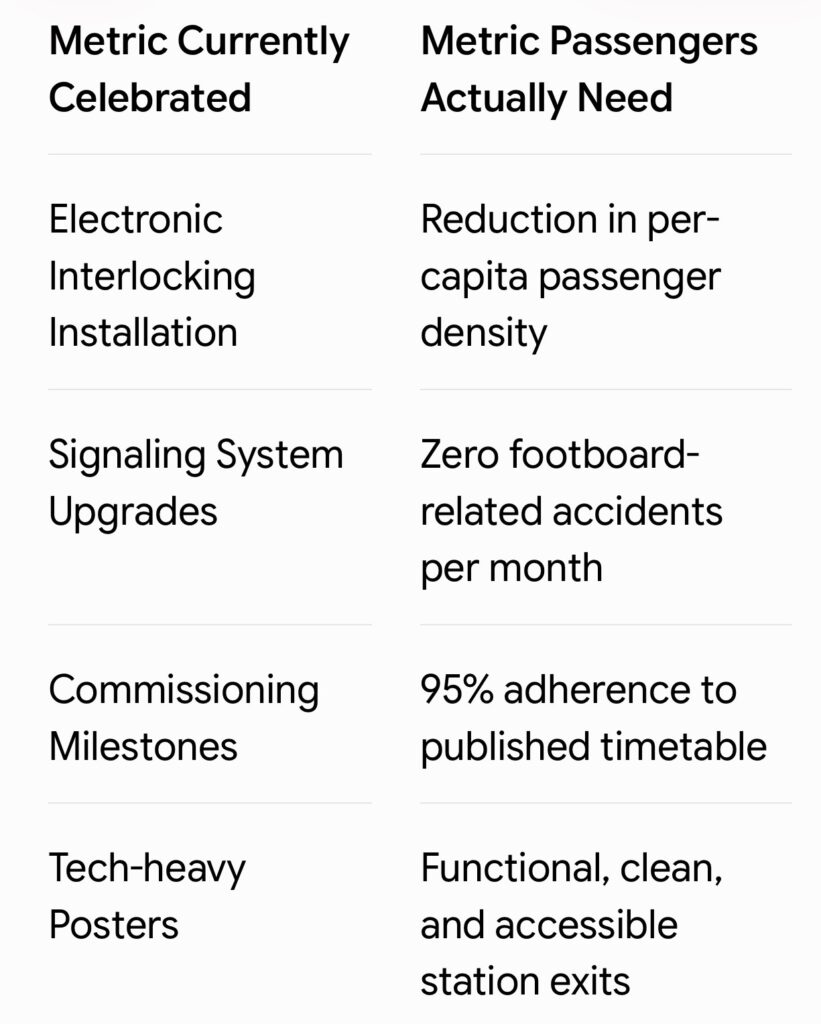
If the Western Railway replaced their “Major Modernization” posters with a public tracker showing the reduction in train headway (time between trains) or the number of additional coaches added to the fleet this quarter, they would find a public that is actually eager to celebrate their success.
To shift the Railway Board’s culture from “babudom” (bureaucratic self-adulation) to genuine operational accountability, we must examine the structural incentives currently in place. The disconnect exists because the people who report the “successes” are not the ones who face the consequences of systemic failure.
The Problem: The “Siloed” Responsibility Model
Currently, the Railway Board operates in vertical silos. The Signaling & Telecommunications (S&T) department measures its success by the number of systems commissioned, while the Operations department measures success by train movement. When these goals are not aligned with passenger outcomes (safety, capacity, and punctuality), the organization defaults to vanity metrics.
Proposed Shift: The “Integrated Outcome” Framework
To pivot toward operational accountability, the following organizational changes are essential:
1. From Departmental KPIs to Passenger-Facing KPIs
Instead of rewarding departments for “installing systems,” performance bonuses should be tied to System Performance Indicators.
- The Change: An S&T engineer should not just be evaluated on “Electronic Interlocking commissioning,” but on the mean time between signal failures affecting peak-hour operations.
- The Incentive: Align personal career advancement with the stability and efficiency of the network as experienced by the user, not just the technical completion of a project.
2. The “Unified Command” for Suburban Networks
Mumbai’s suburban network is a unique entity that requires a specialized management structure, rather than being treated as just another division within the Western Railway.
- The Change: Establish a dedicated “Suburban Authority” with independent budgetary control for infrastructure upgrades, directly accountable to an ombudsman who represents passenger interests.
- The Incentive: This would eliminate the dilution of responsibility between various railway departments and focus all resources on the specific, high-density needs of the suburban commuter.
3. Institutionalizing the “Post-Incident Audit”
Currently, systemic issues are often buried under bureaucratic reports after a disaster.
- The Change: Every infrastructure failure—whether it’s a signaling glitch, a derailment of an empty rake, or a fire—must be followed by a public-facing, root-cause analysis report.
- The Incentive: By making these reports mandatory and accessible, the organization faces real-world consequences for repetitive failure. It forces the management to stop “beating the drums” for routine work and start focusing on deep-rooted maintenance and technical integrity.
As long as the “Bade Sahab” (Dhurandhar Fame) mentality persists, the organization will continue to celebrate the tools of the trade (like a new signaling system) while ignoring the purpose of the trade (moving people safely).
By linking the career trajectory of senior officers to measurable, public, and passenger-centric data—rather than internal milestone reports—the railway can force a shift from performative management to professional, outcome-based engineering. The infrastructure upgrades would then become the silent, reliable backbone of the service, rather than the subject of self-aggrandizing PR campaigns.
To illustrate the transition from “vanity milestone” reporting to “passenger-impact” metrics, let’s re-examine the Dadar Electronic Interlocking (EI) commissioning (May 17, 2026) through a critical lens.
The Current “Milestone” Narrative
The Western Railway’s official line highlights:
- “Major Modernization Milestone Achieved!”
- “34-year-old system upgraded to state-of-the-art Electronic Interlocking.”
- “Enhanced safety, reliability, and operational efficiency.”
- “Configured for 112 routes managing 7 lines.”
The “Passenger-Impact” Re-framing
If we strip away the PR gloss and demand operational accountability, this project should have been communicated to the public based on how it actually changes their daily lives.
Here is how that same announcement would look under an “Outcome-Based” reporting model:
PROJECT IMPACT REPORT: Dadar Signaling Upgrade (May 2026)
1. Operational Reliability Target:
- Goal: Reduction of signal-related technical failures at Dadar station by X% over the next 12 months.
- Accountability: Public dashboard to track “Signal-related delays” at Dadar. If failure rates do not drop, an explanation must be provided to the public.
2. Capacity Enhancement Goal:
- Goal: Increase the hourly train throughput by Y% during peak hours, enabling a reduction in headways (wait times) from current levels.
- Measurement: We will publish the “Average Wait Time” between trains at Dadar before and after this commissioning to prove the “operational efficiency” claimed.
3. Safety Metric:
- Goal: Zero incidents of signal-linked train conflicts during peak transition periods.
- Accountability: Full transparency on any “near-miss” or signal discrepancy investigations related to the new system.
The Comparative Shift
To better understand the paradigm shift required in how the railway administration communicates with the public, we can contrast the current vanity-driven approach with a necessary, outcome-based model.
Currently, the administration relies on “PR Milestones,” where the successful installation of a system—like the Dadar Electronic Interlocking—is treated as the ultimate achievement. In this model, success is defined by technical completion, the focus is on modernization for its own sake, and the primary output is a glossy poster or infographic.
Conversely, an “Outcome-Based” model prioritizes “Passenger Metrics.” Here, the installation is merely a tool, and success is defined by measurable improvements in the daily commute. Under this framework, the focus shifts to the Mean Time Between Failure (MTBF), and the goal is a demonstrable reduction in peak-hour wait times. The proof of success is not a poster, but a documented, real-time increase in daily train frequency and improved punctuality, ideally monitored through a public, transparent dashboard.
By moving from a culture that celebrates the act of installation to one that is held accountable for the results of operation, the railway can transition from self-congratulatory marketing to professional, service-oriented engineering.
Why This Matters
By shifting the narrative, you force the administration to define success as “commuter relief” rather than “project completion.” Currently, the Railway Board treats the commissioning of a system as the end-state. In a passenger-centric model, the commissioning is merely the beginning of a mandatory performance period. If they want to claim “operational efficiency,” they must prove it with the data that matters most to the commuter: Are there more trains? Are they on time? Is the platform less crowded?