

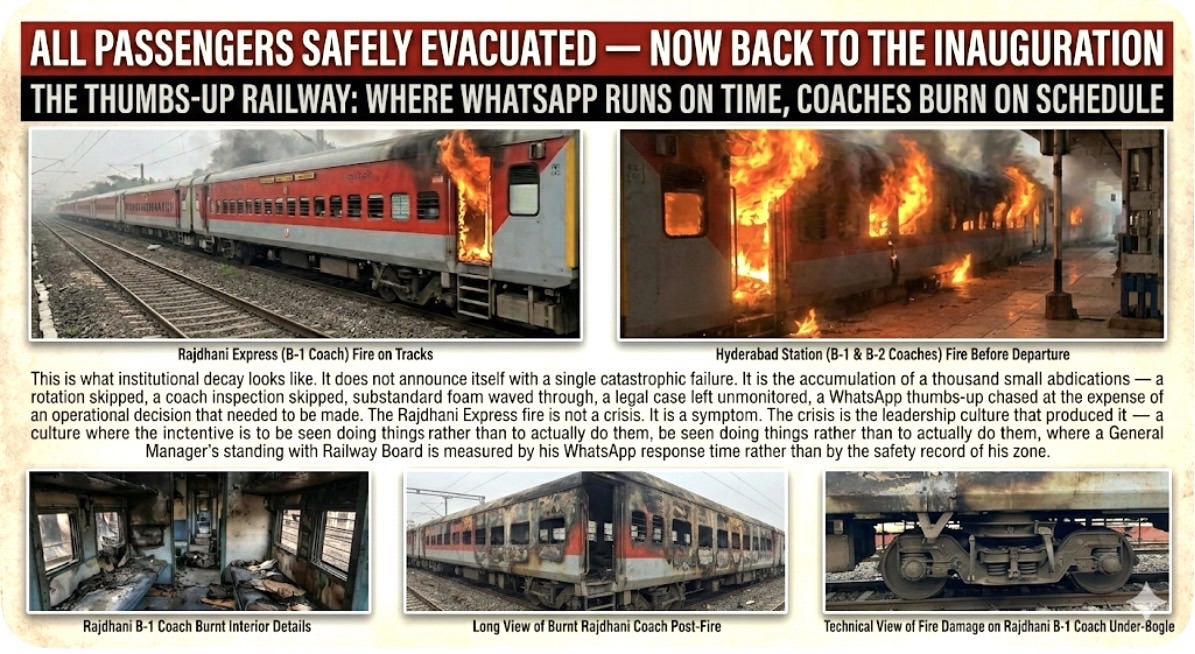
All Passengers Safely Evacuated — Now Back to the Inauguration
The Thumbs-Up Railway: Where WhatsApp Runs on Time, Coaches Burn on Schedule
At 5:15 in the morning on May 17, somewhere between the Nagda-Kota section forgettably named stations of Luni Richha and Vikramgarh Alot in Madhya Pradesh, the B-1 air-conditioned coach of Train No. 12431 — the Thiruvananthapuram–Nizamuddin Rajdhani Express, which is to say one of Indian Railways’ most prestigious trains — caught fire. The fire spread rapidly through the coach within seconds. Sixty-eight passengers were asleep inside. They got out. No casualties or injuries were reported. The coach was detached. A press release was issued. Senior officials “rushed to the spot.” And by afternoon, Indian Railways had moved on..
Just remember these five articles once again and go ahead..
25.10.2025: “What is the role of a Division, Zone and Railway Board: Getting Basics correct, Part-I”
26.10.2025: “What is the role of a Division, Zone and Railway Board: Getting Basics correct, Part-II”
23.02.2026: “Brain Fog of Railway Board, Part-1”
24.02.2026: “Brain Fog of Railway Board, Part-2”
24.04.2026: “Brain Fog of Railway Board, Part-3”
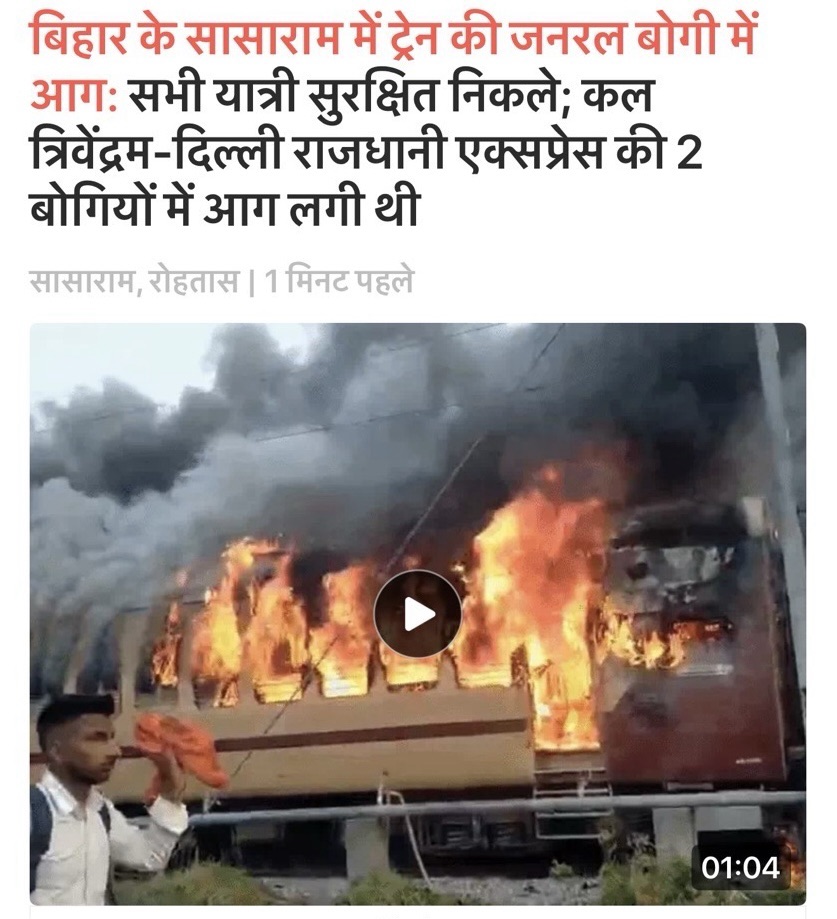
That is the problem, isn’t it. We have perfected the art of moving on
The Senior Divisional Commercial Manager Saurabh Jain said, “railway staff promptly evacuated all passengers, separated the affected coach, and informed the fire brigade, state administration, and railway authorities.” All very efficient in the aftermath. The question nobody is asking loudly enough is why, with thermographic inspection tools available to field staff, with detailed maintenance schedules, with an entire electrical engineering cadre spread across zones and divisions, the B-1 coach of a Rajdhani Express was in a condition to burst into flames at 5 AM on a Sunday. Fires of this nature do not appear from nowhere. They are built, slowly, through accumulated neglect — a wire chafing here, a compromised foam there, a supervisor who signed an inspection report without leaving his chair.
Look at the interior of any of these coaches and ask yourself what you see. The seat covers. The foam cushioning. Despite years of promises, despite Supreme Court nudges, despite internal circulars from Railway Board that pile up like sediment, the combustible material inside Indian Railways coaches remains exactly what it was a decade ago: “synthetic fabrics and foam that, when they burn, burn catastrophically fast. The supply of this material continues because the vendors who supply it are not ordinary vendors. They are, as anyone inside the system will tell you in whispered confidence, vendors with reach — reach into offices that are supposed to be checking the quality of what goes into these coaches. Officers and supervisors who raise inconvenient objections tend to find themselves transferred or penalised. This is an open secret. It is simply never said in public.”
A Railway Board Member’s WhatsApp Gets More Attention Than a Burning Coach
Now ask where the Senior Divisional Electrical Engineers — the Sr.DEEs — responsible for coaching maintenance — were in the weeks before this fire. The honest answer is: “distracted. Not necessarily incompetent, but distracted.” The electrical engineering branch, like the civil engineering branch, is today largely a support apparatus for inaugurations. A new station is being renovated here, a flagging-off ceremony is being organised there, a VIP inspection is due next week. The DRM needs to make arrangements. The PHOD wants a report. The General Manager has called a video conference. In between all this theatre, the actual unglamorous business of checking coaches — using thermographic cameras, doing proper under-gear inspections, ensuring that smoke detectors in coaches actually work — gets compressed into whatever time is left over, which is increasingly not much.
One is not excusing the people on the ground. Sloppiness is sloppiness and must be called out. But sloppiness flourishes when the people above are not watching, and the people above are not watching because they themselves are watching something else entirely: “the WhatsApp groups.” Those who have had occasion to see the messages that flow between Railway Board members, General Managers and DRMs say the experience is instructive. What one finds is not a serious exchange of operational concerns. What one finds is an elaborate exercise in public genuflection — messages crafted carefully to attract a thumbs-up from the Chairman and Railway Board. The tone, reportedly, is that of courtiers seeking royal favour, not of operational managers flagging problems and seeking solutions. The Minister would do well to ask for a dump of these WhatsApp conversations. He will learn more from that exercise than from any number of root-cause analysis reports.
Root Cause Analysis Dispatched; Root Cause Untouched
The Chairman Railway Board’s response to this fire — as to previous fire incidents — has reportedly been to ask zonal railways and divisions to conduct detailed root-cause analyses, with the Why-Why method as favoured tool. This is a perfectly reasonable instruction. It is also a confession. The body that should be doing that analysis, that should have the institutional memory and engineering depth to look at a coach fire and tell you within forty-eight hours exactly what went wrong and why, is RDSO — the Research Designs and Standards Organisation. That the CRB must turn to a division in Kota for answers rather than to his own apex technical body tells you everything about the condition of that body.
Since the Why-Why method is so beloved, let us apply it honestly — which is precisely what the official analysis will not do. First, on the fire itself:
- Why did the coach catch fire? Electrical fault, likely a short circuit in the wiring or under-gear equipment.
- Why was there a short circuit? Cable insulation had deteriorated beyond safe limits.
- Why had insulation deteriorated? Periodic thermographic and physical inspection of the coach was inadequate.
- Why was inspection inadequate? The Sr.DEE’s department was committed to inauguration support, station renovation supervision, and divisional-level VIP arrangements.
- Why was an electrical maintenance department doing inauguration support instead of maintenance? Because General Managers and DRMs are rewarded for delivery of inaugurations and penalised — through indifference, poor ACRs, and difficult postings — for raising inconvenient safety flags.
- Why does that reward structure exist? Because Railway Board, led by the CRB-on-contract, has organised itself around visible, photographable, flag-off-able outcomes rather than the unglamorous, unfilmable work of keeping a fleet of coaches safe. Which reflects, in turn, exactly what is being demanded from above.
The official Why-Why analysis, one can safely predict, will stop at step three. “Insulation deteriorated due to inadequate inspection.” Corrective action: “inspection schedule to be tightened. Circular to be issued. Filed. Forgotten.”
Now try the same method on the materials:
- Why did the fire spread so rapidly through the coach? Interior materials — foam cushioning and seat covers — are highly combustible.
- Why are combustible materials still installed in coaches despite regulations mandating fire-retardant specifications? #Procurement specifications are not enforced at the supply stage.
- Why are specifications not enforced? Because vendors supplying non-compliant material do so with effective impunity.
- Why do these vendors operate with impunity? Because officers who flag non-compliance are transferred or penalised, and the supervisory chain above them is either indifferent or actively complicit.
- Why is the supervisory chain complicit? Because certain vendors are so politically entrenched that even senior-most Members of Railway Board exercise studied caution around them. The officer who is “inconvenient” to a vendor finds that the vendor is, inexplicably, not inconvenienced in return.
The official Why-Why analysis, one can again predict, will stop at step two. “Foam did not meet fire-retardancy specifications.” Corrective action: “fresh inspection of coach interiors across the zone. Circular to be issued. Filed. Forgotten. The vendor will continue to supply inferior quality of materials.”
This is why the method, however sound in principle, produces nothing when applied by people whose careers depend on not reaching the answer. Root cause analysis is only as honest as the institution conducting it. A Why-Why chain that stops when it begins to inconvenience the powerful is not analysis. It is ritual.
We Sent Officers to IIT and Japan. We Posted Them to Inaugurations
Indian Railways has, over the years, sponsored scores of its officers for postgraduate degrees — MTechs from IIT Kharagpur, advanced technical programmes in Japan. This is not a trivial investment. The taxpayer funded it. The expectation, one would have thought, was that this expertise would flow back into the organisation and strengthen its technical core. So why are these officers not being posted to RDSO? What is the point of producing an engineer with a specialised MTech in structural or materials engineering if he is then assigned to manage a passenger reservation centre or supervise platform tiling for an inauguration? The posting decisions — made by Railway Board, approved at the highest levels — reveal where the real priorities lie with uncomfortable clarity. #RDSO, it seems, is not a posting that attracts the talented or the ambitious. It is where careers are parked when no one is paying attention.
Read: 26.04.2026: “Rationalising IRs’ Technical Training Architecture: The Case for a Unified Centre at Nasik, Part I: The Problem & the Opportunity”
Read: 27.04.2026: “Rationalising IRs’ Technical Training Architecture: The Case for a Unified Centre at Nasik, Part II: The Institutional Case and the Path Forward”
The consequences of this are entirely predictable and have duly arrived. An RDSO deprived of its best minds becomes an RDSO that depends on its vendors for technical direction — which is precisely the situation that obtains today. Finite Element Analysis reports are fudged. #Specifications are written with a particular vendor’s product dimensions already in mind. The officer who raises an objection finds himself at odds with superiors who are, shall we say, obliged to the same #vendor. The #Minister, if he is serious about fixing Indian Railways, must send an unambiguous signal here. Not a circular. Not a committee. A signal — that certain arrangements, long considered untouchable, are about to be touched.
RDSO: Where MTechs Go to Watch Vendors Rewrite Their Own Specifications
The rot in RDSO connects directly to a financial catastrophe that has received far less attention than it deserves. The Supreme Court, on May 8, ruled that #IndianRailways is a “consumer” of electricity under the Electricity Act — not a deemed distribution licensee, as Railways had argued for over a decade. As a consumer, Railways must pay Cross-Subsidy Surcharge and Additional Surcharge like any other large industrial user procuring power through open access. The exposure runs into tens of thousands of crores, making a quiet mockery of Mission 41K — the Railways’ ambitious programme to cut energy costs through green and open-access electricity procurement.
The case had been pending since 2015. The legal position of Railways was considered, by those who drafted it, to be watertight under the Railways Act. It was not watertight. Senior officers who handled this subject during their tenures are, by all accounts, stunned. They are stunned because a case of this magnitude — involving statutory interpretation of two Central Acts and the financial sovereignty of a constitutional entity — is not something that should be left to drift through the system on autopilot. It is the job of the Chairman and Members of Railway Board to ensure that such cases are tracked, argued properly, and won. Instead, the senior leadership was engaged in root-cause analyses and video conferences, and the case drifted to section officers who, whatever their diligence, were simply not equipped to defend it at the Supreme Court level.
One is tempted to apply the Why-Why method here too:
- Why did Indian Railways lose a case it considered watertight? Because it was defended inadequately at the appellate and Supreme Court levels.
- Why was it defended inadequately? Because senior legal and operational oversight of the case had lapsed.
- Why had oversight lapsed? Because the Members and Chairman were otherwise engaged.
This is what institutional decay looks like. It does not announce itself with a single catastrophic failure. It is the accumulation of a thousand small abdications — a rotation skipped, a coach inspection skipped, substandard foam waved through, a legal case left unmonitored, a WhatsApp thumbs-up chased at the expense of an operational decision that needed to be made. The Rajdhani Express fire is not a crisis. It is a symptom. The crisis is the leadership culture that produced it — a culture where the incentive is to be seen doing things rather than to actually do them, where a General Manager’s standing with Railway Board is measured by his WhatsApp response time rather than by the safety record of his zone.
The passengers on that train between Luni Richha and Vikramgarh Alot were lucky. They got out. Next time, we may not be so fortunate. But until the Minister demands accountability from the top — not a root-cause analysis from a division, not another Why-Why chart filed in a zonal headquarters, but actual accountability from the people who run this railway — luck is all the passengers of the Rajdhani Express have.
And luck, as anyone who has studied engineering failures will tell you, is not a system.