

Senior Scale Ad-Hoc to Group ‘B’ Officers in Indian Railways: A Legal and Administrative Analysis
STS Ad-Hoc to Group ‘B’ Officers—it goes against the spirit of the DOPT’s general instructions on ad-hocism
The issue of Ad-hoc promotion of Group ‘B’ officers to Senior Scale (Level-11) in the Indian Railways has been a long-standing point of contention involving the Railway Board, the Department of Personnel and Training (DoPT), and the Judiciary.
The Railway Board has technically re-authorized these promotions as of January 2026, despite previous restrictions. This move is seen as a “firefighting” measure to address the massive vacancy crisis, even though it goes against the spirit of the DOPT’s general instructions on ad-hocism.
The promotion of Group ‘B’ (Class II) officers to Senior Scale (Level 11) on an ad-hoc basis in Indian Railways has become a flashpoint for legal battles. Critics and Direct Recruit (DR) associations often label this practice a “fraud” or an “manipulation” on the cadre structure, while the Railway Board defends it as an “administrative necessity.”
This article examines the actual position based on official DoPT guidelines, Railway Board orders, and Supreme Court rulings-
The Context: Group ‘B’ to Senior Scale
In the Organized Services of Indian Railways (IRSME, IRSEE, IRTS, etc.), the hierarchy typically moves from:
- Junior Scale (Group A – Level 10): Entry level for Direct Recruits (UPSC).
- Senior Scale (Group A – Level 11): The first promotion level.
The Rule: Senior Scale posts are technically Group ‘A’ posts. Under normal Recruitment Rules, they should be filled by Group ‘A’ Junior Scale officers with 4 years of service.
The “Ad-Hoc” Practice: When there is a shortage of Group ‘A’ Junior Scale officers, the Railway Board allows Group ‘B’ officers—who are technically subordinate to Group ‘A’—to “officiate” in Senior Scale posts on an ad-hoc basis.
DoPT Position: The “Stop-Gap” Rule
The Department of Personnel and Training (#DoPT), which is the nodal agency for service rules in India, has consistently opposed prolonged ad-hocism:
- OM dated 30.03.1988 & 15.12.2023: DoPT instructions state that ad-hoc promotions should only be made in exceptional circumstances for a period not exceeding one year.
- No Seniority/Pay Rights: DoPT rules explicitly state that ad-hoc promotion does not bestow any right to regular appointment or seniority in that grade.
- Directive to Discontinue: DoPT has repeatedly asked the Ministry of Railways to stop the practice of “Senior Scale Ad-hocism” and instead fill vacancies through regular promotions or by following the 50:50 induction quota strictly.
Railway Board’s “Revival” (2026 Position)
Despite DoPT’s stance, the Railway Board issued a significant order on January 27, 2026 (No. 2025/E(GC)16-8), reviving the scheme of Senior Scale ad-hoc promotion for Group ‘B’ officers until 2028.
Board’s Justification:
- Operational Safety: Significant vacancies in Senior Scale were allegedly affecting railway safety and operations.
- Shortage of JS Officers: A lack of eligible Group ‘A’ Junior Scale officers (who require 4 years of service) left no choice but to promote Group ‘B’ officers.
Current Order Conditions:
- Priority 1: Group ‘A’ JS officers with 4 years service.
- Priority 2: Group ‘A’ JS officers with 3 years service (officiating).
- Priority 3: Group ‘B’ officers with 6+ years of service in Level 8/9 (ad-hoc).
- Duration: Limited to 1 year at a time, total scheme ending in 2028.
Legal Position: What the Courts Say
The “fraud” allegation usually stems from how these ad-hoc periods are later used to claim “weightage” in seniority.
A. The Supreme Court Stance (R.K.Kushwaha Case, 2018)
In a landmark judgment (07.09.2018), the Supreme Court provided a surprising shield to the Railways:
- Railway Rules vs. DoPT: The Court held that the Indian Railway Establishment Manual (#IREM) has statutory force under Article 309. If IREM rules (like Rule 334) allow for weightage or specific seniority fixation, they can override general DoPT circulars.
- Validity of Weightage: The Court upheld the practice of giving up to 5 years of weightage (ante-dating seniority) to Group ‘B’ officers when they are eventually permanently inducted into Group ‘A’.
B. The “Quota-Sifting” Fraud (HC Observations)
While the SC protected the rules, the Patna High Court and others have flagged “procedural fraud”:
- Excess Inductions: The 50:50 ratio between Direct Recruits (DR) and Departmental Promotees is often bypassed. Courts have noted instances where promotees were inducted in numbers 3 to 4 times higher than DRs by manipulating “vacancy calculations.”
- Ad-Hoc as a Permanent Fixture: Courts have criticized the Railways for keeping officers on “ad-hoc” status for 10-15 years, which effectively bypasses the UPSC’s oversight of regular promotions.
Summary of the “Actual Position”
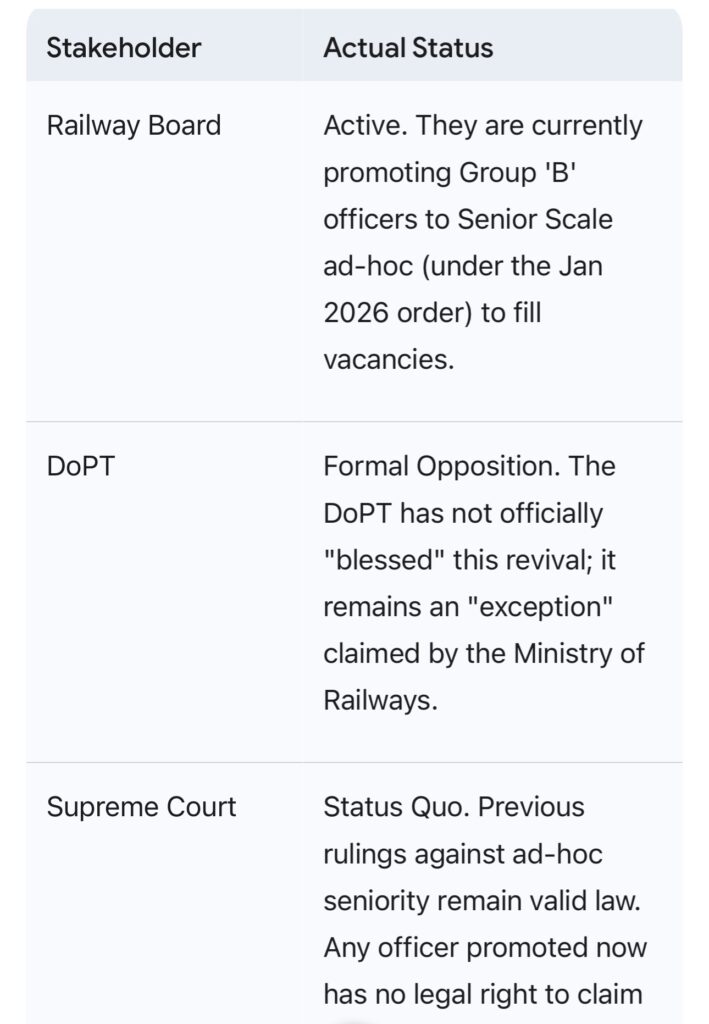
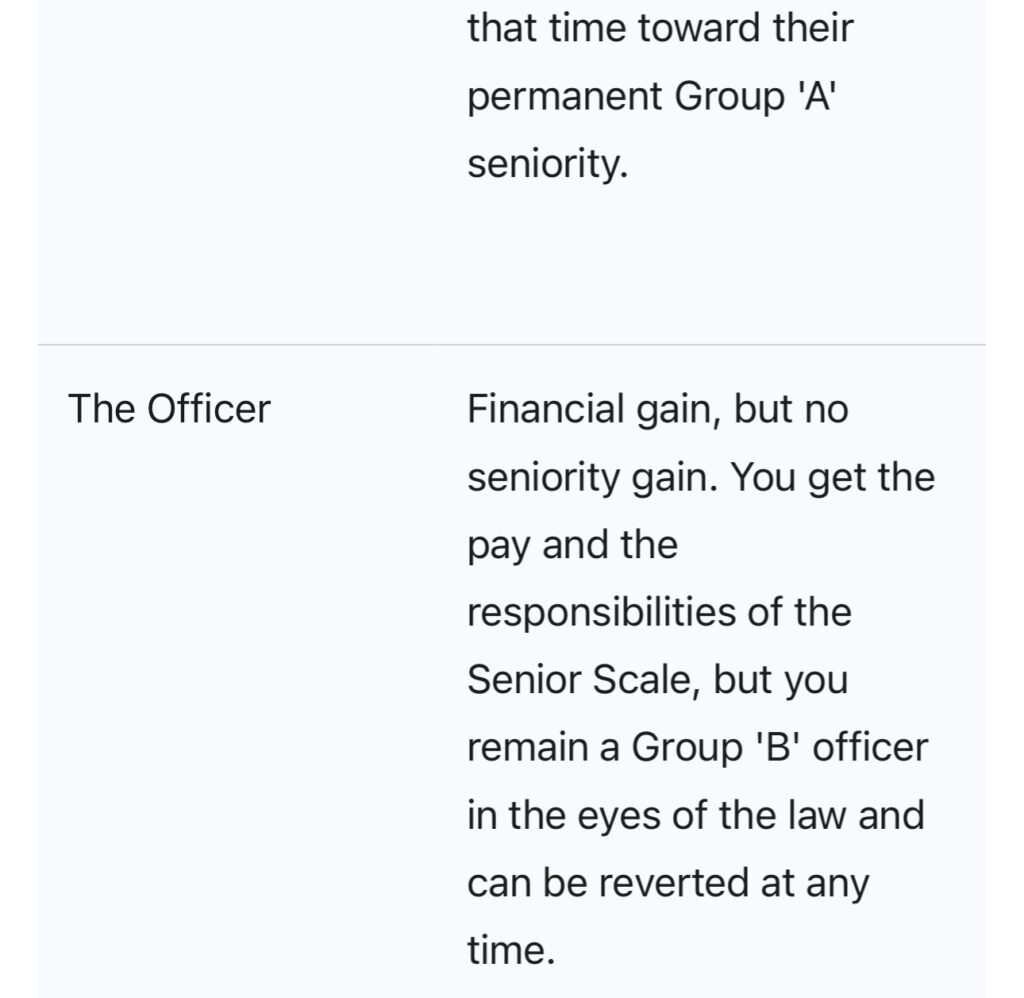
The “actual position” is a classic case of administrative necessity clashing with legal and regulatory policy. While the Supreme Court and DoPT have set strict boundaries to prevent “ad-hocism,” the Railway Board has recently exercised its executive powers to restart the practice to prevent a collapse in operations. Here is the summary of the actual position as of April 2026:
Legal & Regulatory Restriction—The “No” Position
- DoPT Directive: The Department of Personnel and Training explicitly ordered the discontinuation of ad-hoc promotions for Group ‘B’ officers to Senior Scale (STS) after December 31, 2019. This was part of the transition to the Indian Railway Management Service (IRMS), intended to clean up seniority disputes.
- Supreme Court Stand: The Court has consistently ruled that ad-hoc service cannot be counted for seniority. In various cases, it has held that “stop-gap” promotions should not be used to bypass regular recruitment rules (RRs). Promoting Group ‘B’ to a Group ‘A’ Senior Scale post is technically a “diagonal” promotion that the courts view with skepticism if it lasts for years.
Railway Board’s Recent Shift—The “Current Reality”
- The Revival (January 2026): Despite the 2019 ban, the Railway Board issued Letter No. 2025/E(GC)16-8 on January 27, 2026, officially reviving the ad-hoc promotion scheme.
- Why? The Railways faced a “functional emergency.” With thousands of vacancies in Senior Scale (Level-11) posts—which are critical for safety and train operations—the Board determined that leaving these posts vacant was a higher risk than violating the DoPT’s administrative preference.
- New Terms (2026–2028): The revival is temporary (valid until 2028). It allows Group ‘B’ officers with 6+ years of service in Level-8/9 to be promoted to Senior Scale only if no eligible Group ‘A’ officers are available.
The “Actual Position”
Conclusion: Is it “Correct”?
Technically, it is administratively authorised—by the Railway Board—but legally fragile. It is “correct” from an operational standpoint—the trains must run—but “incorrect” from a service law standpoint—because it violates the standard model of cadre management. For an individual officer, it is a beneficial “stop-gap” that provides higher pay, but it offers no long-term protection against future seniority litigation. Contd..