

Ministry of Railways sanctions Final Location Survey for Devgarh Madariya-Marwar Jn Broad Gauge Rail line
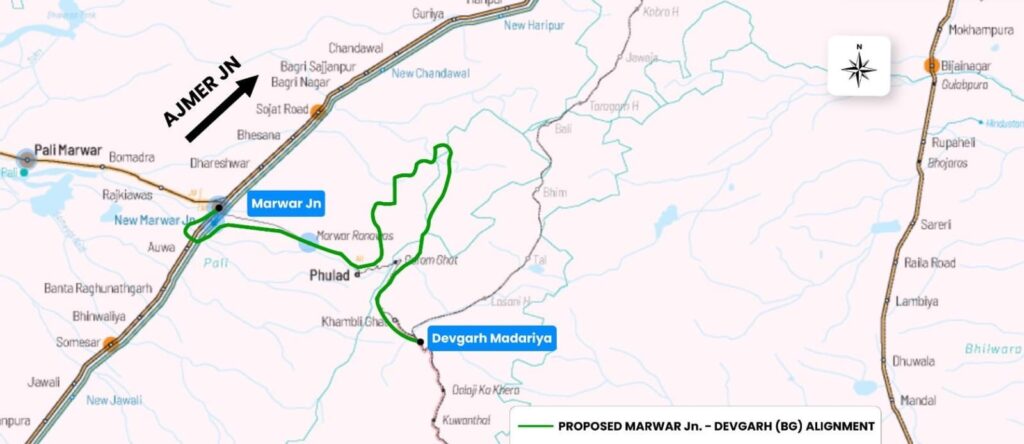
New Delhi: The Ministry of Railways has approved the Final Location Survey (#FLS) for a new broad gauge line of 72 kms railway line connecting Devgarh Madariya to Marwar Junction. Once approved, this project will provide the shortest and most direct rail route from Jodhpur and Bikaner to Chittorgarh and Udaipur.
It will significantly reduce travel time and enhance passenger and freight movement across Rajsamand, Udaipur, and Pali districts, bringing modern rail access to underserved areas.
With this, farmers’ produce, such as the fruits and vegetables of Devgarh Madariya, will gain access to new markets in the Marwar region and reduce logistics costs for local communities.
This line will pave the way for faster train operations through the Marwar region, turning the once-slow narrow tracks into a lifeline of faster, more efficient connectivity.
These developments are strategically aligned with the Delhi–Mumbai Industrial Corridor (DMIC), particularly benefiting the Jodhpur–Pali industrial area—an emerging manufacturing and logistics hub in western India. Improved rail infrastructure will not only strengthen supply chains but also attract investments, expand trade, and connect industrial centers more efficiently with ports and markets across the country.
Tourism and local economies will also witness a surge, as this line will improve access to destinations such as Kumbhalgarh Fort, Charbhuja Temple, and Dwarkadheesh Temple (Kankroli). The improved connectivity will promote local enterprises, handicrafts, and service sectors.
Rajasthan’s marble, granite, and cement industries stand to gain from lower logistics costs and faster freight movement under Indian Railways’ Mission 3000 MT, which aims to enhance freight capacity and efficiency across the network.
Once approved, this project along with the undergoing 82 km Nathdwara–Devgarh Madariya broad-gauge conversion project worth ₹969 crore will bring socio-economic benefits to the Bhil, Garasia, and Sehariya tribal communities by improving access to education, healthcare, and employment opportunities.