

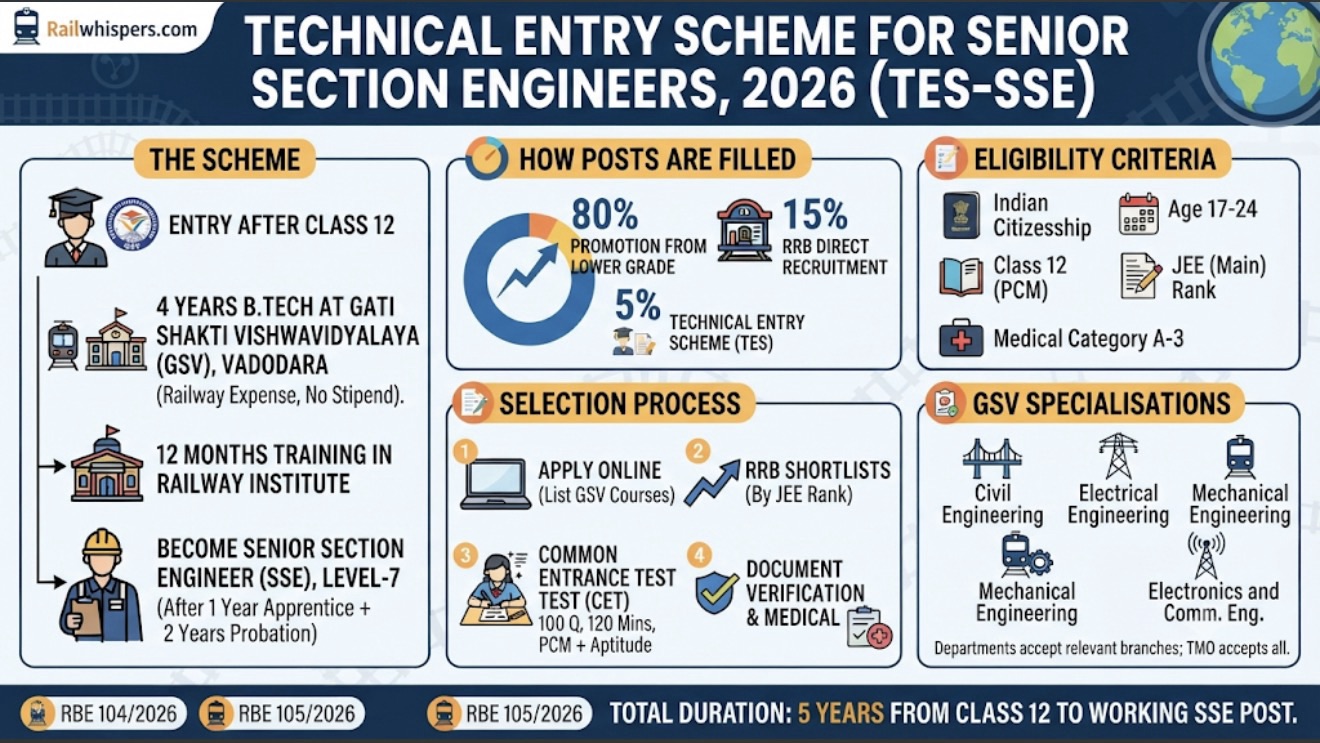
Part-1: Technical Entry Scheme for Senior Section Engineers, 2026
Editorial Note: A very significant development has gone unnoticed by the railway officers and supervisors. We are presenting a curated brief of the policy before we analyse it. Our preliminary assessment reveals that this will have long-term impact on existing supervisory cadres and on the training infrastructure of Indian Railways. What is intriguing is the silence. Perhaps this policy went unnoticed.
1. What the scheme is
The Railway Board issued two letters on 20.11.2026 under file E(NG)II/2024/RR-1/2Part. They create a new entry route to the post of Senior Section Engineer (SSE) in Pay Level-7.
In the Technical Entry Scheme (#TES), a candidate joins after Class 12. The candidate studies a 4-year B.Tech at Gati Shakti Vishwavidyalaya (#GSV), Vadodara, at railway expense. The candidate then trains for 12 months in Railway Institute and becomes an SSE. The scheme covers the Civil, Electrical, Mechanical, and Signal and Telecom departments. RBE 104/2026 describes the scheme. RBE 105/2026 amends the recruitment rules.
2. How SSE posts will be filled
RBE 105/2026 divides the SSE posts in each department as follows:
- 5% through TES, from the open market, through the Railway Recruitment Boards (RRBs).
- 15% through direct recruitment by the RRBs, plus any unfilled TES posts.
- 80% through promotion from the next lower grade.
The Board can change the split between TES and direct recruitment. The promotion share does not change, so TES takes its 5% from direct recruitment.
3. Who can apply
A candidate needs:
- Indian citizenship.
- An age of 17 to 24 on 1 July of the admission year, with the usual relaxations.
- A Class 12 pass with Physics, Chemistry and Mathematics.
- A JEE (Main) rank from the current year. For the 2027-28 session, only the better of the two 2027 scores counts.
- Medical category A-3 under the Indian Railway Medical Manual.
4. How many seats
The yearly intake is 5% of SSE vacancies or the GSV training capacity, whichever is less. The Board fixes it each year from the indents of the zonal railways and production units.
5. How candidates are selected
- Candidates apply online and list the GSV courses in order of preference.
- The RRB shortlists by JEE rank. It calls candidates up to the 90th percentile rank, or 15 times the seats, whichever is fewer.
- Shortlisted candidates take the Common Entrance Test (CET).
- The RRB verifies documents, conducts the medical examination and allots a GSV course by CET merit and preference.
The Board names one RRB to run the selection. An exam conducting agency holds the test for it. The selection has four steps:
The CET has 100 multiple choice questions in 120 minutes. Part A has 60 questions on general aptitude. Part B has 40 on Class 12 Physics, Chemistry and Mathematics. Three wrong answers cost one mark. The qualifying mark is 20% for all categories. A tie goes to the older candidate.
6. The course at GSV
Each candidate signs a bond before the course. GSV offers four courses, each specialised in rail engineering:
- Civil Engineering.
- Electrical Engineering.
- Mechanical Engineering.
- Electronics and Communication Engineering.
Each department accepts these courses: - Civil accepts Civil only. Its Track Machine Organisation (TMO) accepts all four courses.
- Electrical accepts Electrical, Mechanical, and Electronics and Communication.
- Mechanical accepts Mechanical, Electrical, and Electronics and Communication.
- Signal and Telecom accepts Electrical, and Electronics and Communication.
The railways pay for the course. The student receives no stipend. A student who breaks the bond pays the bond amount, which the letters do not state. The Board waives the bond if the Central Government selects the graduate for a higher post.
A student who takes longer than four years pays for the extra period. That student also loses seniority against batch mates who finished on time.
7. Appointment
After the course, the graduate passes a fresh medical examination and document verification. The Board allots each graduate to a zonal railway or production unit by GSV performance and preference.
The graduate then trains for 12 months on the apprentice stipend and must pass. Two years of probation as an SSE on Level-7 pay follow.
Appointment dates from the start of probation, not the course. Seniority follows the rules for direct recruits. From Class 12 to a working SSE post takes five years.
8. The role of the RRBs
In the 15% share, the RRBs recruit graduates for posts, as before. In the 5% share, one RRB selects Class 12 students for a course. Its work ends at GSV admission. The letters give it no part in the appointment four years later. Contd.