


RLDA has come under a fresh cloud of controversy
Raising concerns among industry stakeholders that the amendment came too late to restore a fair and competitive bidding environment
The specifications for Officer’s Chair and Executive Chair remain highly restrictive and closely aligned with proprietary market designs commonly associated with a leading branded furniture supplier
Now only the name of the furniture manufacturer firm has been removed and their specifications have been added which no one else can make because the design is patented
New Delhi | The Rail Land Development Authority (#RLDA) has come under a fresh cloud of #controversy after #Tender No. RLDA/WKS/04/2025-26 for the manufacturing and supply of furniture items including chairs was reportedly reissued for the third time with substantially unchanged technical specifications, triggering allegations that the bidding conditions continue to favour a single established furniture manufacturer.
Documents reviewed by #Railwhispers, including the Bill of Quantities and the recently issued corrigendum, suggest that the specifications for Officer’s Chair [BoQ 21(i)] and Executive Chair [BoQ 21(ii)] remain highly restrictive and closely aligned with proprietary market designs commonly associated with a leading branded furniture supplier.
Read: “RLDA: Acting Against Spirit of Atmanirbhar Bharat—A Case of Incompetence & Malice”
Read: “Dishonest and corrupt practices is being follow in RLDA for awarding PMC Services”
The matter has assumed greater significance after a #corrigendum was issued at the fag end of the tender process, raising concerns among industry stakeholders that the amendment came too late to restore a fair and competitive bidding environment.
Specs Allegedly Mirror Single-Vendor Design
Sources in the furniture and procurement sector told #Railwhisper that the tender conditions appear to be drafted around specific design architecture rather than performance-based standards.
The specifications include features such as:
- high-back revolving chairs with headrest
- synchronized seat-back movement
- fixed dimensional tolerances
- specific PP moulded structures
- aluminium armrest assemblies
- defined foam density and hardness values
- particular lumbar and tilt mechanisms
According to industry experts, these are not generic functional requirements but design-led features that resemble patented or model-specific configurations, potentially discouraging equivalent manufacturers from participating.
One #vendor representative, requesting anonymity, said, “This is not a neutral tender specification. It reads more like a product sheet than a public procurement document.”
Possible Breach of GFR & CVC Norms
Procurement experts have flagged possible violations of #GFR 2017 Rule 144(i)(b), which discourages the use of trademarks, patents, and brand-linked specifications in public tenders unless justified by exceptional circumstances.
The rule also requires that procurement conditions must not be discriminatory or restrictive in nature.
Repeated republication of the same #tender without widening the #specifications may also run contrary to #CVC principles on fair #competition and #transparency, especially where earlier concerns were already raised.
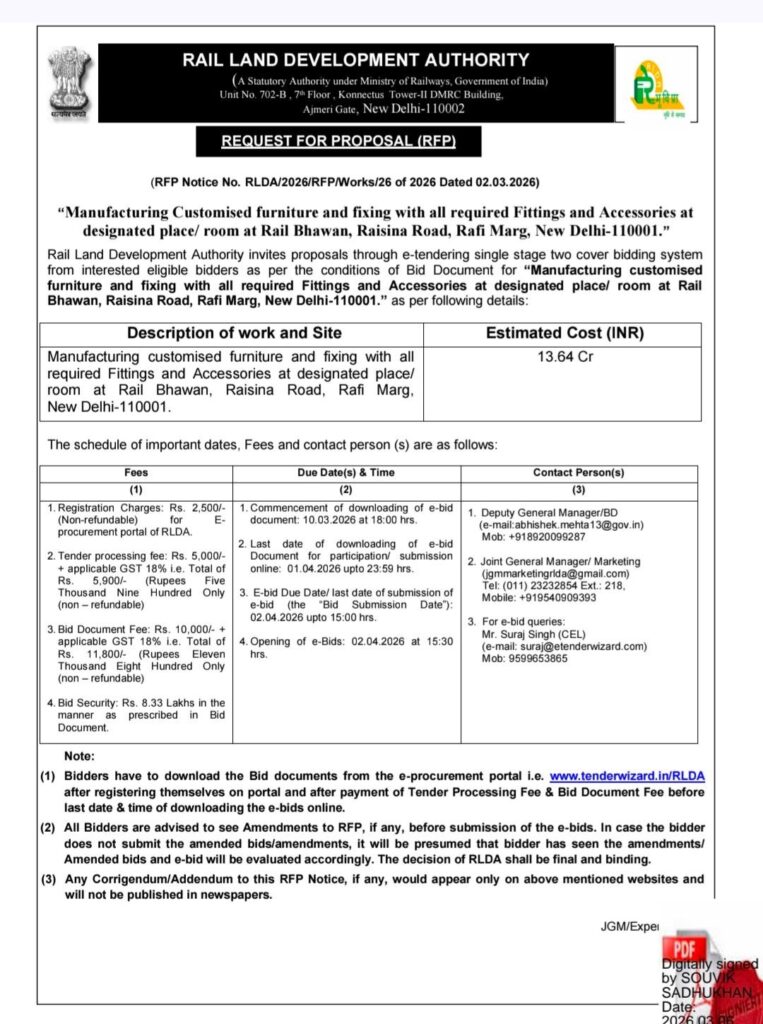
#Railwhisper had earlier highlighted similar apprehensions in rail-sector furniture procurements, where stakeholders alleged that narrow technical clauses were effectively locking out competition.
Third Reissue Deepens Suspicion
The fact that the tender has now reached a third reissue without substantial genericisation of technical clauses has intensified concerns.
Industry observers say that repeated reissuance without addressing core specification issues could indicate either:
- procedural indifference, or
- a deliberate continuation of restrictive conditions.
Questions are now being raised on whether the concerned field and finance officers failed to intervene despite repeated red flags from vendors and market participants.
Late Corrigendum Raises Eyebrows
The timing of the corrigendum has become another major flashpoint.
Stakeholders argue that issuing amendments just before bid closure undermines the spirit of open competition because several eligible firms may already have decided not to participate based on the original restrictive terms.
A senior procurement consultant told #Railwhisper: “A corrigendum at the eleventh hour does little to undo the damage if the original specs already discouraged market participation.”
Call for ED-Level Intervention
With allegations now gaining traction, there is growing demand for senior-level intervention at Executive Director (#ED) or #Board level to examine whether the specifications should be redrafted into generic, performance-based standards, such as:
- standard foam density bands
- BIFMA-compliant mechanisms
- ergonomic benchmarks
- “or equivalent” clauses
#Stakeholders say such intervention is essential to preserve the integrity of the procurement process and ensure that public tenders do not appear tailor-made for a single #patent holder or preferred vendor.
PS: All related documentary evidence is available with Railwhispers.