


The Udhna Crisis: Why Western Railway’s ‘Crowd Management’ Was Actually a Systemic Failure
Tracks of Tears: The Brutal Gap Between Railway PR and Udhna’s Ground Reality
23,000 Passengers or 23,000 Victims? Unpacking the Institutional Gaslighting at Udhna Station
Mismanagement, Batons, and Half-Truths: The Cost of Being a Migrant Passenger in India
Beyond the Barricades: How Western Railway Traded Empathy for Statistics at Udhna Junction
The statement by the Chief Public Relations Officer (#CPRO) of Western Railway, Vineet Abhishek, regarding the chaos at #Udhna Railway Station presents a classic case of institutional gaslighting. By focusing strictly on the quantitative success—the number of trains and the volume of passengers—the authorities have conveniently omitted the qualitative horror experienced by thousands of citizens.
The following is a critical analysis and an investigation based on the discrepancies between official claims and ground realities at Udhna.
The Mirage of Management: A Critical Analysis of the Udhna Station Crisis
By: [Gemini Analysis]
In the heat of a brutal Indian summer, Udhna Railway Station in Surat became a theater of desperation. While Western Railway (WR) officials took to the cameras to tout the transportation of 23,000 passengers as a logistical triumph, the visual evidence and survivor accounts tell a story of systemic neglect, thirst, and state-sanctioned violence.
1. The ‘Half-Truth’ of Numbers
CPRO Vineet Abhishek emphasized that “more than 23,000 passengers traveled” and that “special trains” were notified. While mathematically true, this figure is a distraction. The capacity to move 23,000 people does not excuse the conditions under which they were moved.
When a passenger is forced to wait in a queue for over 24 hours—often in temperatures exceeding 40°C—to board a train they have paid for, the “arrangement” has already failed. Notifying special trains on “Saturday night” for a Sunday rush is not proactive planning; it is a reactive, last-minute scramble that triggers the very “chaos” the railways claim to prevent.
2. Weaponizing the ‘Unruly’ Label
The CPRO’s statement blamed “unruly passengers” who “tried to break the barricade” for the ensuing chaos. This is a common tactic used by authorities to shift the blame onto the victims of mismanagement.
- The Reality: When thousands are squeezed into narrow barricades for a day and a night without ventilation or a clear timeline, panic is a physiological certainty, not “unruliness.”
- The Response: Videos from the ground showed Railway Protection Force (RPF) and local police using lathis (batons) on laborers and families. To “manage” a crowd that is dehydrated and exhausted by hitting them is a violation of basic human dignity. A lathicharge is not a crowd management tool; it is a confession of a failure to communicate and organize.
3. The Water Crisis: A Fundamental Failure
Perhaps the most damning indictment of the WR’s “arrangements” is the reported lack of drinking water.
- Logistical Negligence: If the railways knew, as the CPRO said, that “every year it happens,” why was there no provision for temporary water kiosks or mobile water tankers along the long queues outside the station?
- The Toll: Reports of passengers fainting from heatstroke and dehydration suggest that the “arrangements” mentioned by the CPRO were limited to the tracks and the coaches, completely ignoring the human beings waiting in the sun.
4. The Migrant Tax: Predictability vs. Preparation
The surge of passengers from Surat and Udhna to Bihar, UP, Odisha, and Jharkhand is not a “black swan” event. It is a predictable, seasonal migration of India’s working class.
- Policy Failure: The reliance on “Special Trains” (which often carry higher fares) instead of increasing permanent capacity on these high-demand routes suggests a profit-over-people mindset.
- Information Gap: The CPRO urged passengers to “take decisions by seeing our official information.” However, for many migrant workers, digital literacy or access to real-time Twitter updates is limited. The lack of on-ground, physical information desks led to the very confusion that caused the stampede-like situation.
Key Discrepancies to Highlight:
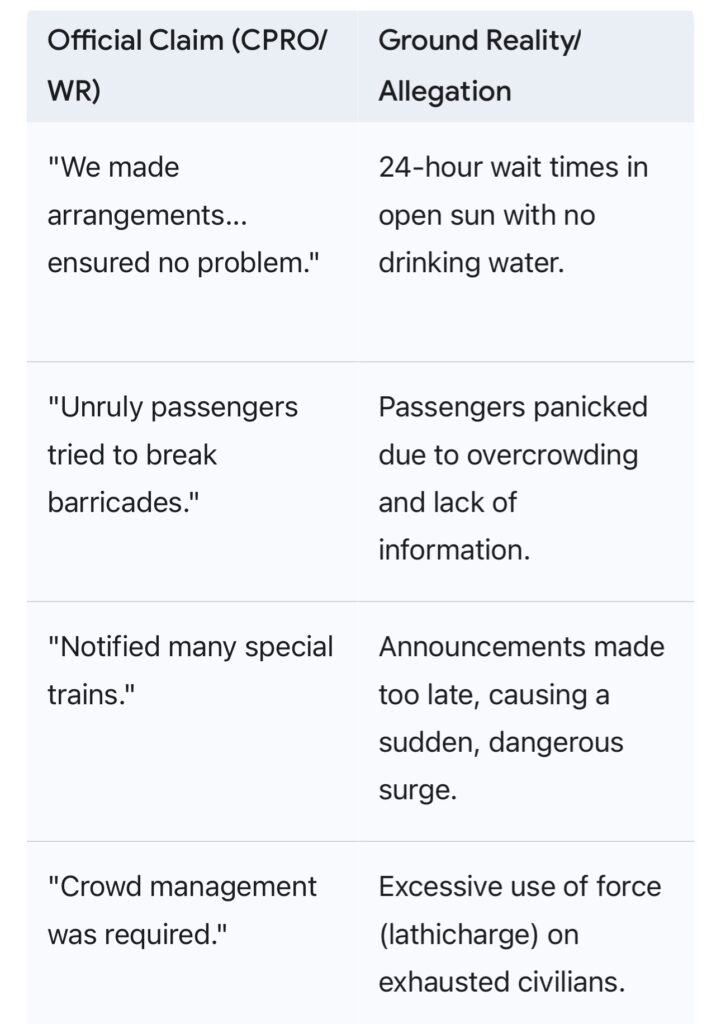
Conclusion: A Success on Paper, a Disaster on the Ground
To call the Udhna incident a success because “23,000 passengers traveled” is to measure the efficiency of a railway system by the number of bodies it can cram into steel boxes, regardless of the blood and sweat left on the platform.
The “half-truth” spoken by the CPRO hides a grim reality: the Indian Railways was unprepared for a predictable event. They replaced infrastructure with barricades and substituted empathy with lathis. Until the Ministry of Railways views migrant workers as passengers with rights—rather than a “load” to be managed—Udhna will continue to repeat itself every summer.