

MSME Under Pressure, Big Corporate Debt Gets Resolution: Is India’s Credit System Fair?
New Delhi: The growing concerns among India’s Micro, Small and Medium Enterprises (#MSMEs) are no longer limited to taxation and compliance. A larger question is emerging around access to government contracts, bank finance and the treatment of stressed loans.
Many MSME entrepreneurs are asking a simple question:
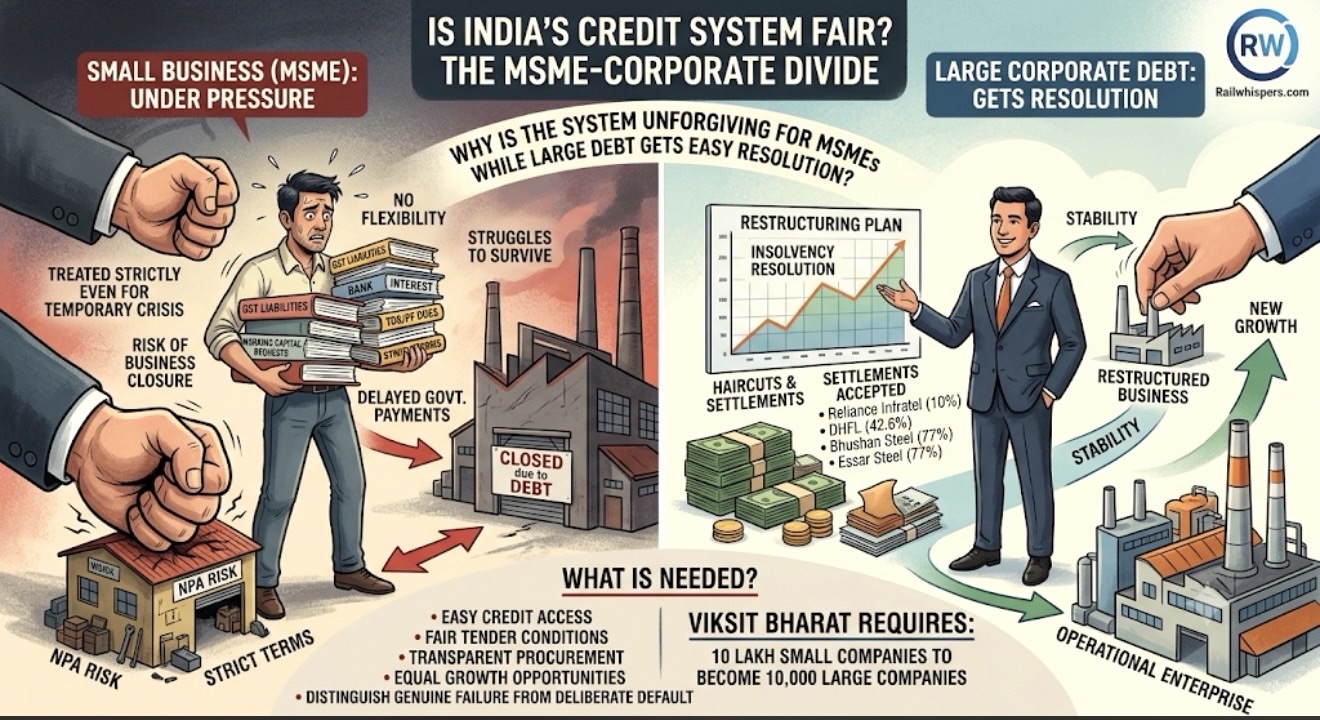
When a small businessman struggles to repay a bank loan, why does the system appear so unforgiving, while large corporate borrowers can enter restructuring, insolvency resolution, settlements and write-offs involving thousands of crores?
The question deserves a serious, data-based debate.
₹12.08 lakh crore written off by public-sector banks
According to data cited by the Finance Ministry from RBI records, public-sector banks wrote off approximately ₹12.08 lakh crore between FY2015-16 and FY2024-25. The government has clarified that a write-off does not mean that the borrower’s liability has automatically been waived; banks can continue recovery proceedings.
The scale is nevertheless enormous.
For comparison, SBI alone accounted for more than ₹2 lakh crore of write-offs during the ten-year period FY2014-15 to FY2023-24, while Punjab National Bank accounted for around ₹94,700 crore, according to government data reported by The Economic Times.
The important question is therefore not simply:
“How much was written off?”
It is:
“How much was ultimately recovered, from whom, and what was the economic impact?”
NCLT cases show another side of the story
Under the Insolvency and Bankruptcy Code, several large corporate insolvency cases have resulted in creditors accepting substantially less than their admitted claims.
Some prominent examples include:
1. DHFL
- Admitted claims: approximately ₹87,248 crore
- Realised under the resolution plan: approximately ₹37,167 crore
That represents recovery of roughly 42.6% of admitted claims.
2. Bhushan Power & Steel
- Admitted claims: approximately ₹47,902 crore
- Realised: approximately ₹19,895 crore
The recovery was around 41.5%, implying a substantial haircut against admitted claims.
3. Alok Industries
- Admitted claims: approximately ₹30,707 crore
- Realised: approximately ₹5,115 crore
The recovery was only around 16.7% of admitted claims.
4. Reliance Infratel
- Admitted claims: approximately ₹42,394 crore
- Realised: approximately ₹4,267 crore
That amounted to only about 10% recovery against admitted claims.
5. Lanco Thermal Power
- Admitted claims: approximately ₹33,331 crore
- Realised amount shown in the analysed resolution data: approximately ₹136 crore—less than 1% of the admitted amount.
These examples demonstrate why the MSME community is asking whether the financial system is effectively “too big to fail” for some large borrowers, while small businesses are treated much more strictly.
But there are also successful recoveries
A balanced discussion must acknowledge that not every NCLT resolution resulted in a massive haircut.
For example, in the Essar Steel case, admitted claims were around ₹54,565 crore and creditors realised about ₹42,232 crore—roughly 77% recovery.
Similarly, Bhushan Steel produced substantially better recovery than many other large insolvency cases.
Therefore, it would be incorrect to describe every NCLT resolution as a “loan waiver”.
The real issue is the distribution of risk and recovery—and whether the same financial system gives comparable flexibility to an MSME borrower.
The MSME question
This is where the political and economic debate becomes important.
An MSME contractor or manufacturer may have:
- GST liabilities,
- TDS obligations,
- PF/ESI responsibilities,
- Bank interest,
- Working-capital requirements,
- Tender EMD,
- Performance guarantees,
- Delayed government payments,
- Rising labour and material costs.
A delayed payment can quickly turn a healthy MSME into an NPA.
At the same time, government infrastructure tenders are increasingly becoming larger and may carry substantial turnover, net-worth, experience and financial-capacity requirements.
This creates a concern among smaller contractors:
- Are government tenders becoming so large that only a handful of major companies—Indian or international—can realistically compete?
That is a legitimate policy question.
Who benefits from the new tender economy?
The MSME sector does not necessarily know who is influencing the system or who benefits from individual tender decisions.
But a perception is developing among sections of the MSME community that:
- Small companies are being asked to compete in a market designed increasingly around the financial strength of very large companies.
That perception should not automatically be treated as proof of wrongdoing.
But governments should take it seriously.
If a ₹500 crore or ₹1,000 crore project is packaged in a manner that prevents capable Indian MSMEs from participating, the country may lose something more valuable than a single contract: competition.
The BJP-government question
The political opposition and #MSME community are increasingly asking whether the present economic model under the BJP-led government is creating an environment in which large corporate groups have greater access to major infrastructure opportunities while smaller entrepreneurs bear a disproportionate share of taxation and compliance.
That allegation requires evidence on a tender-by-tender and borrower-by-borrower basis.
But the government should answer the broader question:
- Is India’s economic policy creating enough space for MSMEs to grow into large companies—or are MSMEs increasingly being pushed into the role of subcontractors to large corporate players?
The real test of Viksit Bharat
India cannot become a developed economy merely by constructing bigger airports, highways, railway stations, ports and industrial corridors.
It also needs 10 lakh small companies to become 10,000 large companies
That requires:
- Easy credit.
- Fair taxation.
- Fast government payments.
- Reasonable tender conditions.
- Transparent procurement.
- Equal access to opportunities.
- And a banking system that distinguishes between a genuine business failure and deliberate default.
The question is not whether large companies should receive credit.
They should.
The question is whether the small entrepreneur gets the same opportunity to survive, restructure, grow and compete?
Because the MSME sector is not merely a group of taxpayers.
It is India’s employment engine, entrepreneurial base and the nursery from which tomorrow’s large Indian companies must emerge.
One uncomfortable question remains:
If a large corporate borrower can get years of restructuring, NCLT resolution and substantial haircuts, why should a small entrepreneur who creates 50 or 100 jobs be treated as a financial criminal merely because his business went through a temporary crisis?
That is a debate India needs to have—with facts, transparency and accountability, not slogans.
#msme #nclt #essarsteel #bhushansteel #npa #sbi #rbi #dhfl #relianceinfratel #alokindustries #lancothermalpower