


A TENDER FOR WHAT, EXACTLY?
How a well-worn procurement mechanism, an unnecessary purchase, and eligibility criteria written with suspicious precision came together in a ₹181 Crore railway tender.
Those who have worked inside railway works contracting for any length of time are familiar with a particular category of arrangement. It does not require conspiracy in the dramatic sense. It requires only an understanding — shared, unspoken, and operationally precise — of how supply-heavy contracts behave once they are awarded.
The mechanism is this. In contracts where the bill of material constitutes a large share of the total value, on-account payments are made progressively as material is supplied to site. The structure exists for legitimate reasons: “large procurement cannot reasonably be front-loaded onto the vendor’s working capital. But the same structure, in the wrong hands, becomes the point of extraction. Material is invoiced at inflated rates. Payments are released against supply. And when the project arrives at the commissioning stage — the stage that requires expertise, sustained presence, and accountability for system performance — the vendor encounters difficulties. Extensions are sought. Scope is renegotiated. In the more accommodating versions of this arrangement, the exit is managed quietly, with the bulk of the financial value already extracted and the commissioning liability conveniently unresolved.”
Officers who have handled works contracts across zones will not find this description surprising. It is not a new pattern. What varies is the scale, the setting, and the degree of institutional scaffolding that surrounds it.
Which makes the question of necessity the first question — and in this case, an answered one.
Western Railway floated a tender in the same category. That tender was subsequently dropped. The reason, as understood within the system, traces to a signal from the Railway Board itself: “that this category of procurement was not considered necessary. The Board’s position, implicit in that outcome, was clear enough to produce a concrete administrative consequence — a tender withdrawn on one railway.”
On the railway under examination here, the tender was not dropped. It proceeded. A ₹181 Crore procurement for a Train Management System (#TMS) on the Mumbai Division of Central Railway — Tender No. CR-BB-TELE-2025-45 — was advertised, bid upon, and evaluated. The advertised value: ₹1,81,37,31,772.98/-.
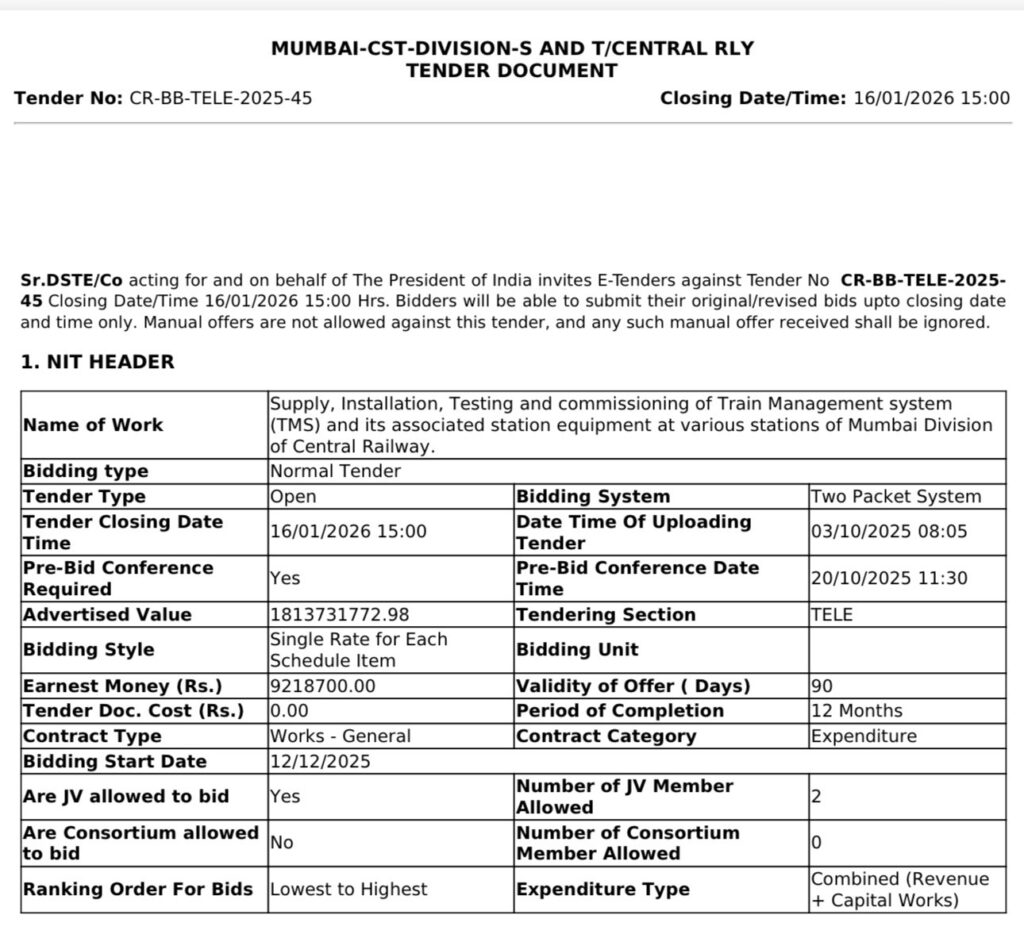
The question of why an adjacent railway read the same institutional signal differently, and what that difference reflects, is one that the tender record alone cannot answer. What the tender record can answer is what happened next.
Many bidders participated. For purposes of this account we focus on L1 and L2, they are referred to as Firm ‘A’ and Firm ‘B’.
The tender was structured as item-wise bidding across 70 items — 65 under Schedule ‘A’ and 5 under Schedule ‘B’. Each bidder was required to quote rates for individual items. The expectation underlying such a structure is straightforward: “independent preparation produces variation. Costs are estimated differently. Overheads are allocated differently. Margins are applied differently. The resulting figures, across 70 items, will diverge.”
Firm ‘A’ and Firm ‘B’ quoted identical rates on every one of the 70 items. The match extends to two decimal places. The aggregate totals are therefore also identical: ₹1,81,37,31,772.98 — precisely the advertised estimated value.
To be direct about what this means statistically: “the probability of two independently prepared bids arriving at the same figure across 70 line items, each to two decimal places, under normal competitive conditions, is not low. It is not a rounding artefact. It is not a coincidence that probability theory has a comfortable home for. The figures were not prepared independently. That is the conclusion the evidence supports.”
The further question — of how both bidders arrived at a total matching the advertised estimate to the last paisa, and what that implies about the confidentiality of the estimate — is one that a proper inquiry would not leave unasked.
Within the 70-item structure, one line item warrants separate attention.
Schedule Item A21 — a DLP 4K Video Wall — was quoted at a base price of ₹72,27,18,660.00 by both firms, with a uniform 40% discount applied, yielding a net price of ₹43,36,31,196.00. This single item constitutes approximately 40% of the total Firm ‘A’ bid value.
Examined through the lens of the mechanism described at the outset, the significance of this concentration is not difficult to read. A high-value supply item, front-loaded in cost, positioned within a contract structure that releases on-account payments against material supply, represents the point at which the arrangement becomes most productive. Whether that is the intent here is a question for investigators with access to internal correspondence. That the structure creates the opportunity is a matter of arithmetic.
The eligibility architecture of this tender raises a separate set of concerns — and these are concerns of a different character, because what is absent from a tender document is—in many cases, more revealing than what is present.
The Mumbai Suburban network handles approximately 1,800+ train movements daily. A Train Management System operating in that environment is not a peripheral application. It interfaces in real time with signalling infrastructure that is safety-critical. System failures in this context are not performance events. They are operational emergencies.
Against that operational context, the tender defines eligible bidders by reference to a broad category of signalling works — RRI, Electronic Interlocking, Kavach, ETCS — without specifying any qualification criteria for the OEM whose system would actually be deployed. No prior experience threshold for large-scale TMS installations. No demonstrated performance criteria for comparable density environments. No requirement that the OEM have successfully commissioned a system of equivalent scale.
The effect of this omission is to permit participation by entities whose domain expertise in the specific challenge of TMS integration under live, high-density suburban operations has not been established or evaluated. In a mission-critical environment, that is not a drafting gap. It is a design choice — and the design choice favours entry over competence.
Whether this was an oversight or a considered outcome is a question the document cannot answer by itself. What the document can answer is this: “a tender above ₹50 Crore is required under standard railway procurement rules to include a reverse auction clause.” This tender, valued at ₹181 Crore, does not contain one. The clause is not modified, not waived with stated justification, not addressed. It is absent.
Taken individually, each of these features — the procurement that an adjacent railway declined to make, the identical bids, the concentrated line item, the absent OEM criteria, the missing reverse auction clause — can be assigned an explanation. Procurement anomalies occur. Drafting gaps happen.
Taken together, they describe a tender whose architecture is more consistent with a predetermined outcome than with a competitive process. The mechanism described at the beginning of this account is not an abstraction. It is a sequence of steps. And the steps, in this case, appear to have been laid with some care.
The institution that floated this tender has the means to examine that question. Whether it intends to is the only open variable.
Issue of Discount needs to be addressed head on. Public procurement is based on two axioms: for transparent and fair price discovery, it is assumed that bidders act independently and that buyer is independent of bidder. In instant case bidders have colluded and someone inside buyer’s office leaked information. So how can price discovery be fair? So how can such a tender be decided?
This publication invites responses from officials of Central Railway and the Railway Board. Source protection is maintained without exception.
— Railwhispers.com