

Shielding Misconduct: Analyzing the Contradictory Stance of Railway Unions Amidst Criminal Convictions
The intersection of labor union activism and individual criminal accountability has reached a critical flashpoint within the Mumbai Division of Central Railway. A detailed analysis of recent judicial outcomes, internal disciplinary orders, and union protests reveals a troubling pattern: “the potential use of institutional pressure to shield their supporters, active members or office bearers and staff from the consequences of gender-based harassment and public misconduct.”
1. The Khatape Conviction: Abuse of Authority as an Office Bearer
On May 4, 2026, Special judge S. V. Sahare in a special court delivered a landmark judgment against #RamchandraKhatape, a #TTE and prominent Office Bearer — Working President — of the union.
- Criminal Verdict: Ramchandra Khatape was sentenced to one year of rigorous imprisonment under Section 509 of the IPC for intentionally insulting the modesty of a 17-year-old girl.
- The Findings: The court highlighted that Khatape, as a public servant, failed in his primary duty to serve the public, choosing instead to “threaten” and use “obscene words.”
- The “Cash Grab” Context: The judgment noted that the refusal to provide a #receipt for a fine indicated a #corrupt motive, which escalated into the verbal abuse of the minor passenger and her family.
2. The Jagdish Krishna Precedent: Internal Hostility and Casteism
The union’s current demands must be viewed through the lens of recent disciplinary actions, specifically the Speaking Order (No. BB.C.DAR.MAJOR. 2024.10) dated November 4, 2025, against #JagdishKrishna, #TTI, CSMT.
- The Offense: An Internal Complaint Committee (ICC) proved that Jagdish Krishna used abusive language, passed casteist remarks, and made demeaning comments regarding the marital status of a female colleague.
- The Penalty: Finding him guilty of creating an “intimidating and hostile environment” and causing “sexual harassment at the workplace,” the Disciplinary Authority imposed the maximum penalty: “Removal from service with immediate effect.”
- Current Status: Jagdish Krishna’s first appeal has been rejected at the ADRM level, and his second appeal is pending at the PCCM level. Meanwhile, efforts are being made through various channels to exert pressure for his reinstatement into service.
- The Contradiction: Despite the severity of these findings (sexual harassment and casteism), reports suggest the unions are actively campaigning for his reinstatement, mirroring the support offered to Khatape.
3. Deconstructing the “Dhadak Morcha”: Protection or Impunity?
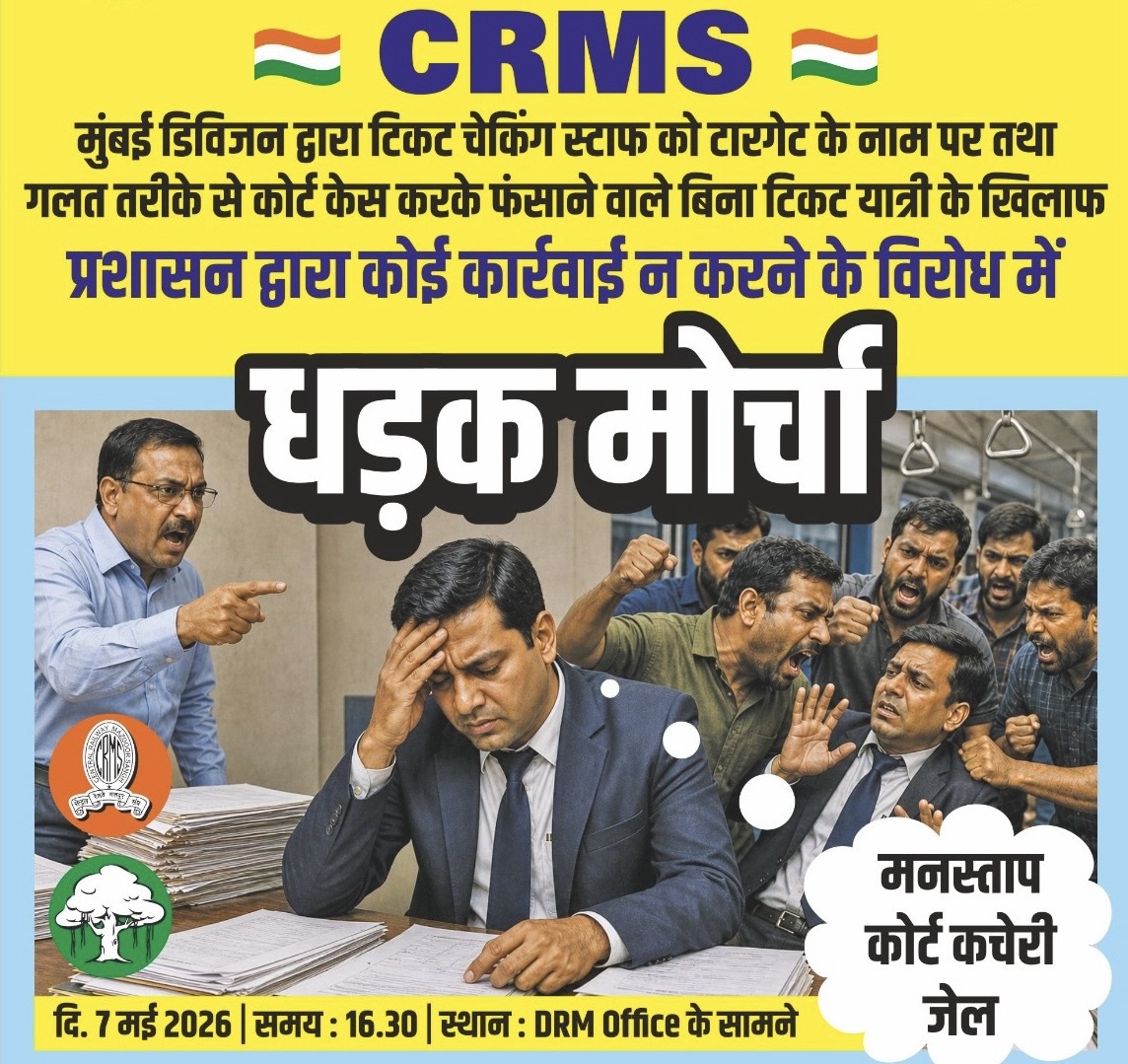
On May 7, 2026—just three days after Khatape’s conviction—the Central Railway Mazdoor Sangh (#CRMS) organized a mass demonstration at the #DRM Office. While the union framed the protest as a defense against “harassment” and “unrealistic targets”, the timing and nature of the demands suggest a different objective.
- Legal Aid for Criminal Acts: The demand for “full legal assistance” in cases of “false litigation” appears to be a direct reaction to the Khatape verdict. Demanding administrative funding for a on-duty staff member’s personal behaviour who convicted of insulting a minor’s modesty is a significant departure from standard labour protection.
- A “Morcha” Against Accountability: By organizing a protest immediately following a judicial conviction of an prominent member, the union risks signaling that it prioritizes the immunity of its supporters and active members over the safety of passengers and even female staff.
- Ignoring the Victim’s Rights: The union’s narrative of “staff victimization” conspicuously ignores the proven victimization of the 17-year-old minor passenger and the female sports staff who were subjected to harassment by their colleagues.
4. Critical Suggestions for Administrative and Union Reform
To restore public trust and ensure a safe working environment, the following actions are recommended:
- Strict Neutrality in Criminal Defense: The Railway Administration must formally state that no legal aid or administrative support will be provided to staff members facing charges or convictions related to sexual harassment (ICC) or offenses against women/minors (IPC).
- Decoupling Union Status from Disciplinary Immunity: The “supporters, active members or office bearers” status of an employee should be an aggravating factor, not a mitigating one, in cases of public misconduct. Leadership roles carry a higher burden of ethical conduct.
- Zero Tolerance for Reinstatement of Harassers: Reinstating individuals like Jagdish Krishna, who were removed following due process for sexual harassment and casteism, would violate the POSH Act and create a legally liable “hostile work environment” for the female employees.
- Public Oversight of Union Demands: Protests that demand protection for staff convicted of crimes should be met with public transparency reports from the DRM office, clarifying exactly why the staff member was disciplined or convicted.
5. Since no further documents regarding the union’s specific correspondence for the reinstatement of Jagdish Krishna are available at this moment, the analysis remains grounded in the verified pattern of behavior established by the existing evidences:
- Direct Link to Conviction: Public reports confirm that the Dhadak Morcha on May 7, 2026, was organized by the Central Railway Mazdoor Sangh (CRMS) specifically in response to the disciplinary action involving Ramchandra Khatape.
- The “Harassment” Narrative: The union’s public stance—characterizing the administration’s actions as “anti-staff” and “harassment”—directly conflicts with the Special Court’s finding that Khatape’s actions were criminal insults to a minor’s modesty.
- Contradiction in Values: The union’s support for an prominent or active member convicted of public abuse (Khatape), alongside its reported efforts for a staff member removed for workplace sexual harassment and casteism (Jagdish Krishna), suggests a prioritization of institutional shielding over the safety of both passengers and female employees.
- Pattern of Disruption: Previous unauthorized protests by CRMS leadership (notably in November 2025) have historically led to severe public safety issues, including commuter fatalities.
Conclusion:
The CRMS “#DhadakMorcha” presents a facade of labour welfare while seemingly acting as a shield for specific individuals convicted of serious moral and legal failures. Protecting the “personal behavior” of offenders like Khatape and Krishna does not serve the general staff; rather, it degrades the professional reputation of the entire Ticket Checking cadre.