


Structural Stagnation: A Report on Procedural Anomalies and the Erosion of Officer Rotation in Technical Wings
Failure to enforce rotations doesn’t just invite corruption; it institutionalizes it !
- Promotion Without Motion: The 12-Year Tenure Trap
- Derailed Rotation: When One City Becomes a Kingdom
- Stationary Power: The High Cost of Bypassing Ethics
- Fixed Tracks: The Scandal of Stagnant Postings
- The Construction Loop: Promotion at the Expense of Integrity
This report analyzes recent administrative orders within the Indian Railways and whistleblower inputs regarding the promotion and posting patterns of senior officials in technical departments. The focus remains on the adherence—or lack thereof—to established governance frameworks and the long-term implications for institutional integrity.
1. Analysis of Recent Administrative Orders
Recent gazetted staff changes indicate a pattern of localized promotion that appears to conflict with standard #rotation policies for “sensitive” posts.
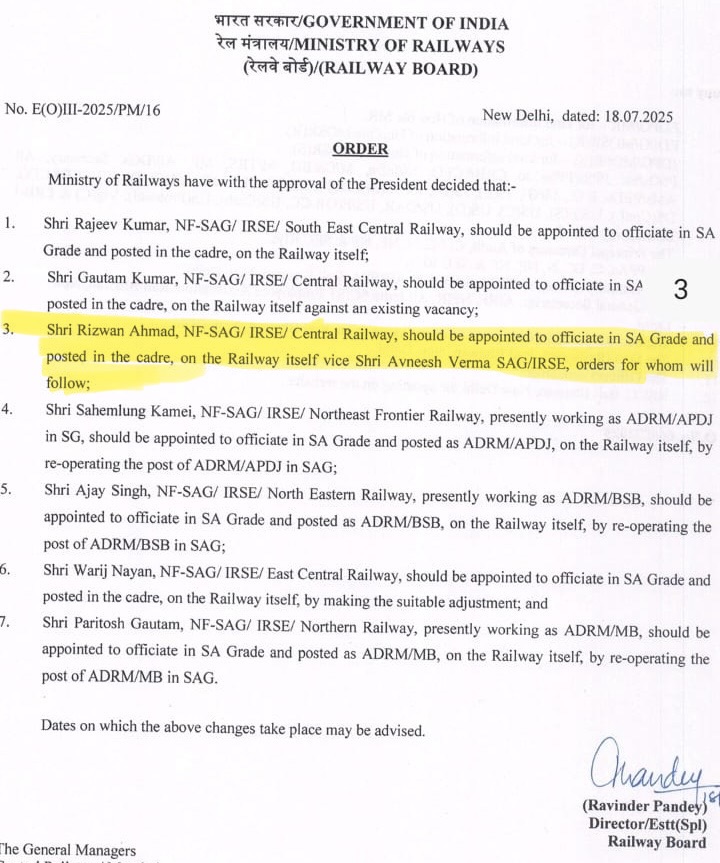
- Railway Board Directive (18.07.2025): The Ministry of Railways approved the promotion of a senior official from #CentralRailway to the Senior Administrative (SA) Grade, specifically directing that the posting be “on the Railway itself”.
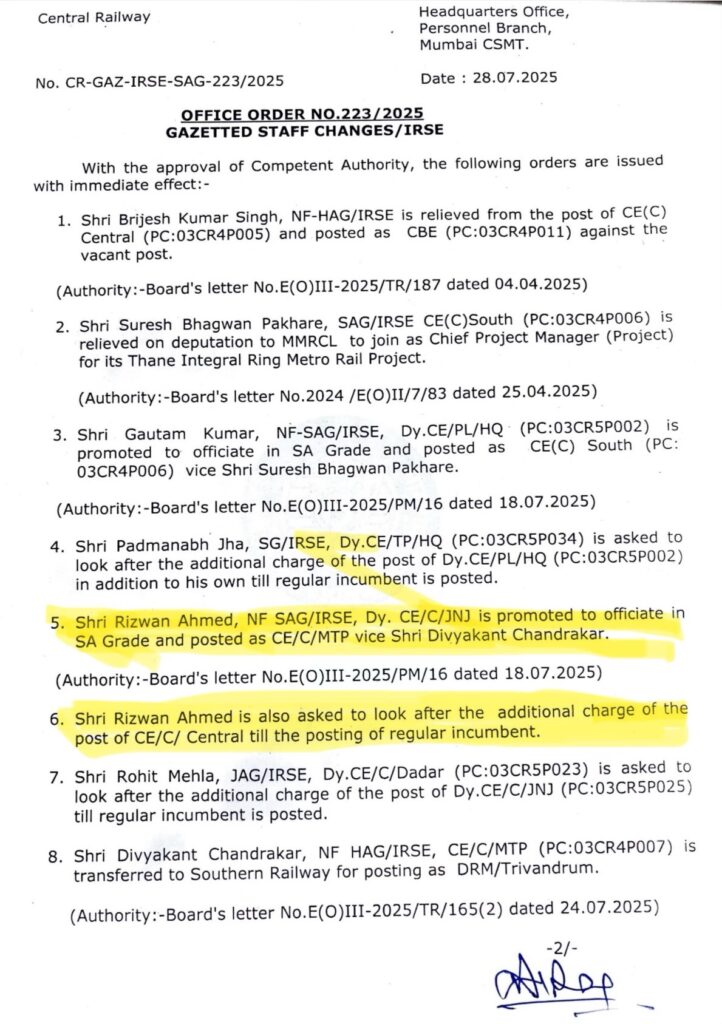
- Zonal Implementation (28.07.2025): Following the Board’s directive, the Central Railway Headquarters issued an order posting this official as Chief Engineer (Construction)/MTP.
- Additional Charges: The same official was further assigned the additional charge of CE/C/Central, effectively concentrating oversight of major construction projects within a single administrative pocket.
2. Reported Anomalies in Tenure & Placement
According to whistleblower inputs, these orders represent a culmination of long-term administrative stagnation:
- City-Level Stagnation: It is reported that the official in question has maintained a continuous presence in the same metropolitan location (Mumbai) for over 12 years, successfully navigating multiple promotion cycles without being transferred out of the zone.
- Unit-Level Promotion: The official was promoted from a Deputy Chief Engineer (#DyCE) position directly to a Chief Engineer (#CE) role within the same construction organization. This “vertical promotion” within the same unit is often viewed as a violation of vigilance guidelines designed to prevent the entrenchment of personal networks.
- Allegations of Financial Favoritism: Inputs suggest that the lack of rotation has led to the “regularization” of past adjustments. A specific instance cited involves the Kalyan goods shed, where expenditures on concreting circulating areas were allegedly labeled as “futile” and carried out primarily to favor specific contracting agencies.
3. The Critical Role of Rotation in Governance
The principle of “Mandatory Rotation” for officers in sensitive departments (such as #Construction, #Procurement, and #Stores) is a cornerstone of anti-corruption strategy for several reasons:
- Disruption of “Nexo-Polis”: Long tenures allow for the development of informal networks between officers, subordinates, and private vendors. Periodic rotation ensures these “comfort zones” are disrupted before they can facilitate systematic fraud.
- Institutional Memory vs. Institutional Capture: While experience is valuable, “institutional capture” occurs when a single individual becomes the sole repository of project history, making it difficult for successors or auditors to challenge past decisions.
- Fresh Perspectives: Rotation brings in new oversight, ensuring that long-pending issues or inefficient practices (like “futile expenses”) are scrutinized by an unbiased eye.
4. Adverse Impact on the System
When rotation policies are bypassed through “manipulative orders”, the system suffers the following consequences:
- Demoralisation of Cadre: When technical officers see peers “maneuvering” to stay in lucrative posts or metropolitan areas for over a decade, it discourages meritocracy and encourages others to seek similar “links” rather than professional excellence.
- Manipulation of Tenders: Long-term stagnation enables officers to tailor tender conditions to suit “preferred agencies,” ensuring that only a few eligible firms can participate, thereby destroying competitive pricing.
- Safety and Quality Risks: In technical wings, favoritism in variations and tender regularizations can lead to the use of sub-standard materials or unnecessary works, potentially compromising infrastructure safety.
5. Root Causes of Corruption in Technical Wings
The root cause of corruption in these departments is rarely a single individual; rather, it is a failure of Systemic Checks and Balances:
- Concentration of Power: Giving an officer additional charges of multiple major sections (as seen in the 28.07.2025 order) reduces the number of independent “eyes” on a project.
- Discretionary Authority in Variations: Construction projects often require “variations” (changes in scope). Without rotation, the official who authorized the initial contract is also the one authorizing the (potentially inflated) variation, leading to a conflict of interest.
- Weak External Oversight: When local administrative orders are used to bypass Railway Board or DoPT (Department of Personnel and Training) guidelines, it suggests a breakdown in the hierarchy where “networked” individuals can influence their own career trajectory.
Conclusion
The administrative orders dtd. 18.07.2025 and 28.07.2025, when viewed alongside the reported 12-year tenure of the subject official, present a textbook case of procedural stagnation. There is so many examples available in Mumbai, Delhi, Kolkata and Chennai, and many other major cities too. For a system as vital as the Indian Railways, the adherence to rotation policies is not a mere formality—it is the primary defense against the “Iron Triangle” of corrupt officials, middlemen, and favored contractors. Failure to enforce these rotations doesn’t just invite corruption; it institutionalizes it.