

WHEN MADAM BECOMES THE MESSAGE
OLQ, the Conduct Rules, and the Birthday That Was Never Quite Private
There is a standard that every officer of a government service is expected to carry. It is not written into a single rule, though several rules give it shape. In #military tradition it goes by a specific name — Officer Like Qualities, or #OLQ — and the civil services, while less precise with the label, operate on an identical expectation. It covers, in essence, the conduct of a person who holds public authority: “the maintenance of propriety in all settings, not merely formal ones; the separation of personal appetite from institutional position; the understanding that the office does not end at the office gate. The government bungalow, the railway colony, the club, and the festive occasion are all extensions of the same accountability, because they are all spaces where the officer’s institutional weight is present, whether or not anyone acknowledges it aloud.”
OLQ is—in this sense—not an aspirational quality. It is a precondition. An officer who cannot maintain it is not merely behaving badly in a personal capacity. He is corroding the premise on which the trust of a transferable government service rests.
This publication’s earlier piece on the social architecture surrounding the officer corps of Indian Railways drew a considerable response. Officers wrote in from multiple zones. What they described, in some detail, was a system of informal obligation — “the wife’s wing, the festival gift, the birthday attendance, the social deference owed upward — that had become so normalised it was no longer experienced as pressure but as weather. You did not think about it. You dressed for it. Among the materials shared were so many photographs and videos. But only Two photos are described here because they are not incidental to the argument. They are the argument.”
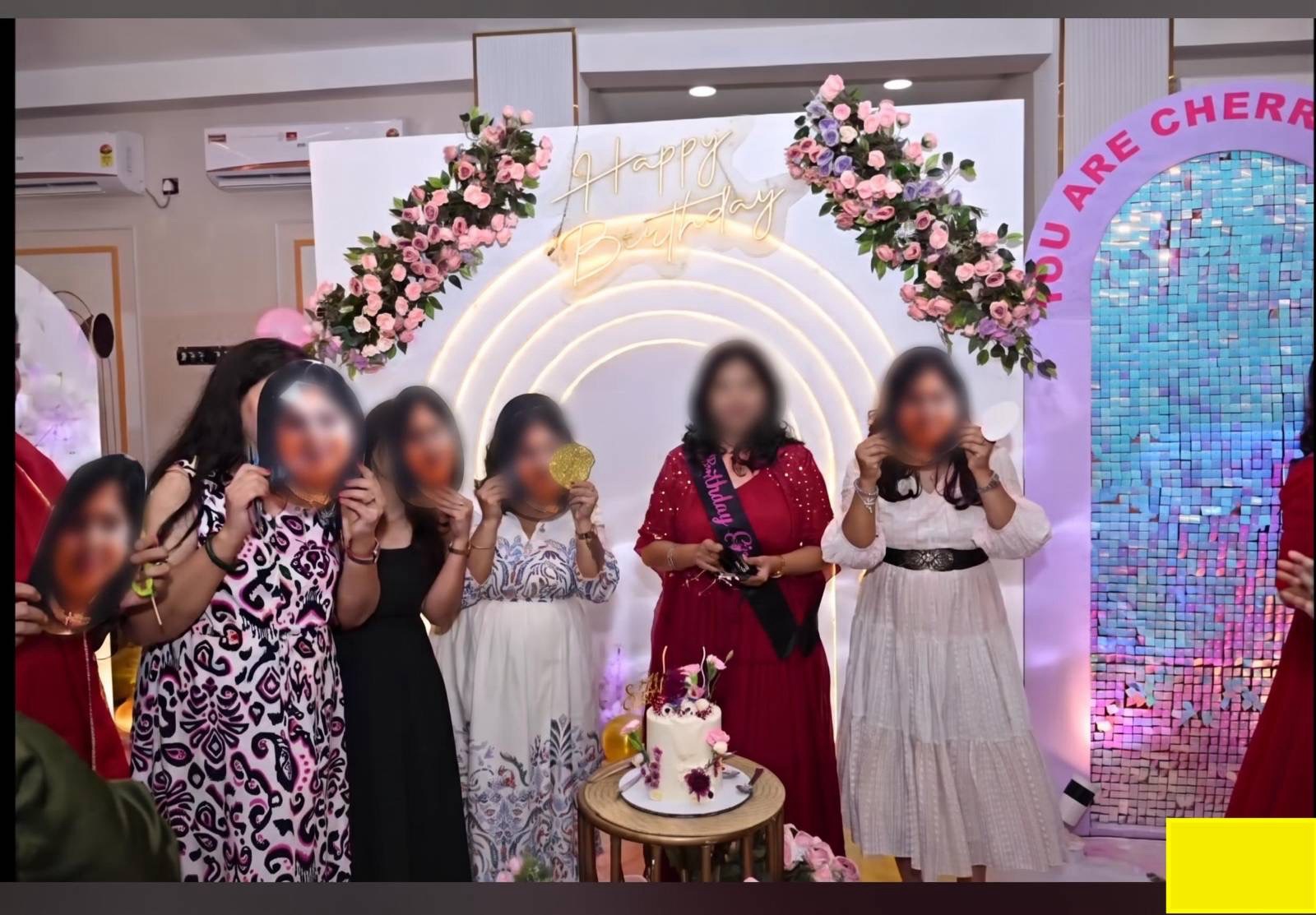
The first photograph shows a large acrylic installation, floor-to-ceiling, constructed to resemble the cover of a fashion magazine. The masthead reads VOGUE. Below it: BIRTHDAY EDITION. A date — April 19th — is printed in the position an editorial date would occupy. The frame carries a Chanel logo. The phrases “Holy Chic” and “Party Guide — Ready to Roll” appear in print. A barcode at the base is captioned: “LIMITED EDITION”. At the centre stands a woman in a purple saree, framed by a heart-shaped arrangement of red flowers. The floor around the installation is covered with pink and grey balloons in substantial number. The backdrop is white draping with flanking lights. The second photograph shows a different event space — a white panelled backdrop lit with neon script reading “Happy Birthday”, large clusters of pink and purple flowers, a decorated tiered cake on a round table, and five women gathered around a woman in a birthday sash.
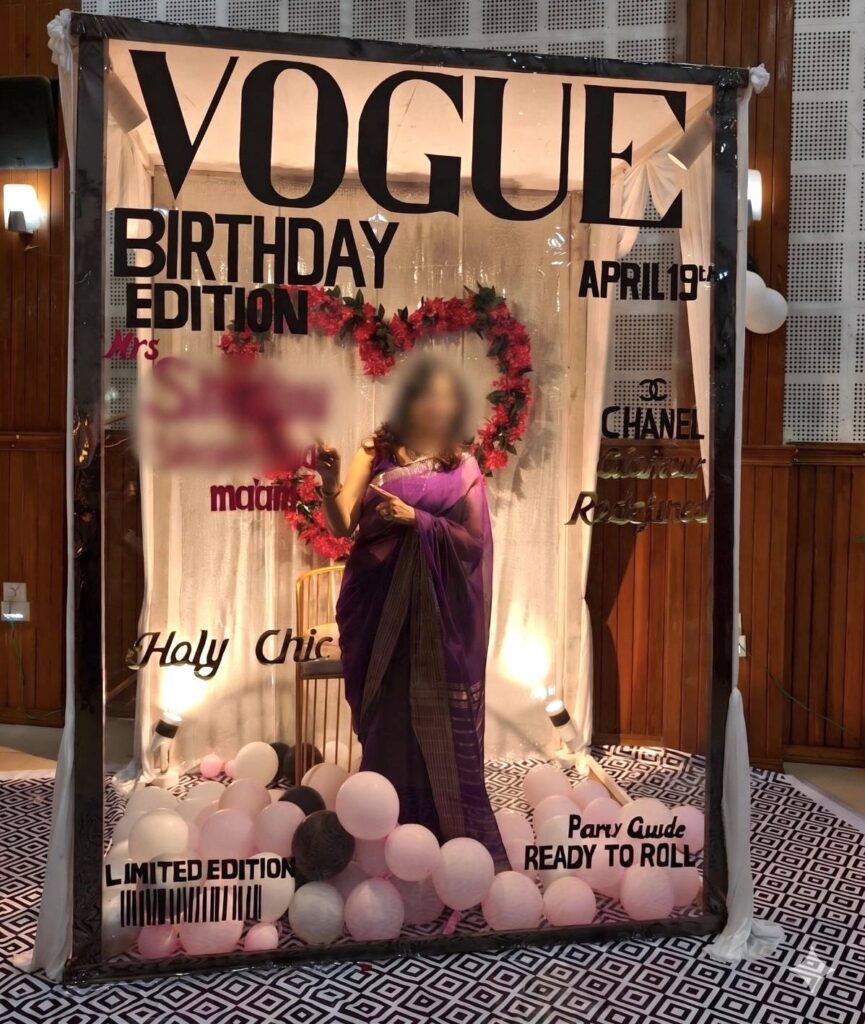
These are not family snapshots from a quiet dinner. A custom fabricated acrylic magazine-cover frame, a neon backdrop, professional balloon work, coordinated floral theming — this is organised celebration, planned and executed with some resource and effort. The individuals in the photographs are not named here and will not be. The images were shared by spouses of serving officers. Their account, stated plainly, is that the woman at the centre of these arrangements is the wife of a serving General Manager of Indian Railways.
The question that follows is not about whether senior officers are permitted to celebrate birthdays. They are. The question is a more precise one: what does the word private mean when applied to a celebration organised around the spouse of the most senior officer in a railway zone, in a service where the careers of dozens of officers are directly subject to that officer’s discretionary authority?
The Railway Services (Conduct) Rules, 1966 address the related question of gifts. A serving officer may not accept from any person with whom he has official dealings any gift beyond a defined ceiling, because the acceptance of advantage — including social advantage — distorts the independence that official decision-making requires. The rule is addressed to the officer, not the household. But in the operational reality of a transferable service, the officer and the household are not separable in any meaningful sense. A gift carried by a junior officer’s wife to a senior officer’s wife’s birthday celebration is not a transaction between two private individuals. It is a transaction between two families that stand in an institutional relationship, one above the other, in a hierarchy where the senior controls the junior’s career documentation. The conduct rules have not been written to cover this situation with precision. The culture has responded to that gap, and not in the direction the rules intended.
What the officers who contacted this publication described is the mechanism. It is not complicated. The invitation to attend a senior’s personal occasion does not arrive as an order. It arrives with all the social warmth of a personal gesture. The compulsion is elsewhere — in what an officer and his family understand will happen if they are consistently absent, consistently ungifted, consistently insufficiently warm. The #APAR — the Annual Performance Appraisal Report — will not record whether the branch officer’s wife attended the GM’s wife’s birthday. It records something adjacent: a general assessment of the officer’s conduct, his interpersonal calibre, his cooperative disposition. The officer completing that section is the same officer whose wife hosted the birthday. The connection is never stated. It does not require statement. Both parties understand the grammar.
This is the machinery. No single act is legible as improper. A birthday party is a birthday party. A gift is a social nicety. An APAR entry about conduct is a professional assessment. The #Corruption is in the aggregate — in the steady, invisible pressure on junior officers and their families to maintain the goodwill of senior households as a career management strategy, distinct from and sometimes in competition with the strategy of performing their actual jobs well. Officers who perform but do not participate have learned that performance is insufficient. Officers who participate adequately have learned that participation is sufficient. The institution’s signal to its officer corps, delivered not through any policy but through a thousand small social occasions, is that access runs through the household.
What the photographs document is one node of that network. The scale of the celebration, the evident resource deployed, the coordinated attendance — none of this happens in a vacuum. It happens because the position that the celebrating family occupies in the institutional hierarchy creates the social gravity that makes it happen. The junior officer’s wife who helped organise the Vogue frame, or who carried a gift to the neon-lit backdrop, or who attended because not attending carried risk — she did not do any of this purely out of affection. She did it because the system she lives inside has taught her, accurately, what the cost of not doing it can be.
This is where OLQ re-enters the analysis, and where the standard is most legibly violated. The question is not whether the senior officer personally extracted anything. The question is whether he created, permitted, or declined to dismantle the conditions that make this extraction possible. An officer who internalises OLQ correctly does not allow his household to become a centre of social gravity that junior households must orbit. He does not allow the occasions of his private life to become occasions of institutional obligation for those below him. He understands that his authority follows him out of the office, and he holds himself to account in proportion to that fact. The standard requires active maintenance, not passive innocence.
Several officers who wrote to this publication noted, with a dry consistency, the specific character of the pressure that the spouse network generates. It is not coarse. It does not announce itself. The mechanism is unambiguous once you have seen it operate. It does not require a raised voice or an explicit threat. A senior officer’s wife mentions to her husband, in the ordinary course of an evening, that a particular junior officer’s wife is charming, attentive, dependable. She does not need to say the opposite about anyone else. Silence accomplishes the same thing.
The junior officer whose wife has been absent from the right occasions, or insufficiently warm when present, or careless with the gift — he simply does not come up. His name does not travel in the conversations that shape the mood around his APAR. At the club evening, one wife is drawn into the inner circle with visible warmth; another is received with the bare courtesy that indicates she has been noticed but not accepted. None of this is recorded anywhere. None of it is actionable under any rule. Every person in the colony reads it without difficulty.
These are the levers. They exist in no service manual. They operate across drawing rooms, lawns, festival gatherings, and birthday celebrations staged behind acrylic Vogue frames. And they work.
One observation that came in, stated without elaboration and requiring none: the officer managing a safety inquiry and managing the social calendar of his senior’s household has, over time, concluded that only one of the two activities reliably affects his career. The other he does because it is his job. The safety inquiry he manages as a professional obligation. The social calendar he manages as a survival necessity.
That is a precise description of what OLQ, in the upper reaches of Indian Railways, has been permitted to become.
Editorial Comment:
We respect every officer’s right to privacy-however, making personal events akin to celestial events where those who report to you are the only ones to participate-then one needs to pause and remind oneself of OLQ. Lady is addressed as ma’am-clearly the gathering is of wives of juniors. Spate of CBI cases have also not woken up the bosses-sadly.
Following publication of the earlier piece, “Railways Runs on Tracks and its Officer Corps Runs on Something Else”, #Railwhispers received communications from serving and recently retired railway officers across multiple zones. Photographs and accounts have been received on the basis of source protection. No individuals are identified by name.