

₹4,500-Crore Railway Surveillance Project on Shaky Ground: Tendering Flaws, Dubious Bidders, and Legal Red Flags
How is the purchaser supposed to ensure compliance if the successful bidder fails to produce certificates later?
How is a level playing field ensured among competing bidders when some have certificates in hand and others don’t?
Should contracts be finalised merely on the presumption that bidders will be able to deliver later? Who is so honest nowadays?
The Indian Railways’ grand ₹4,500-crore plan to blanket passenger #Coaches and #Locos with IP-based Video Surveillance Systems (#VSS) may be headed straight for #derailment. Behind the fanfare, a series of flawed tendering practices and questionable relaxations in #eligibility conditions are casting a long shadow over the project’s viability.
At the centre of the storm lies a seemingly small but decisive flaw: mandatory #Safety and #Security certifications—spelled out in the specifications—are not being demanded at the time of bidding. Instead, #contracts are being awarded on the assumption that successful bidders will “arrange” and “produce” such certificates later, at the inspection stage.
Also Read—July 31, 2025: “VSS Project Procurement: Anatomy of a Scandal”
“This is like issuing a driving licence first and asking for the test later,” said a senior industry veteran. “If bidders cannot prove compliance upfront, they are technically unsuitable. Allowing them to get certificates after the #contract is awarded is nothing but eligibility through the back door.”
A Legal Time Bomb
Experts caution that this presumption could explode into a legal fiasco. If #contractors ultimately fail to produce the required #certificates, the contracts themselves would be void ab initio. Litigation, arbitration, and stalling of the project would be inevitable.
It is learnt that, acting on the instructions of the #CRB, the #EDCC of #RailwayBoard convened a meeting with all Zonal Railways and #ProductionUnits, following which a clarification was issued on 22.09.2025. The circular appeared to acknowledge the problem and directed that compliance with key specifications—such as #MTBF (Mean Time Between Failures), BIS certifications, and security approvals—“must be ensured as on the date of tender opening.”
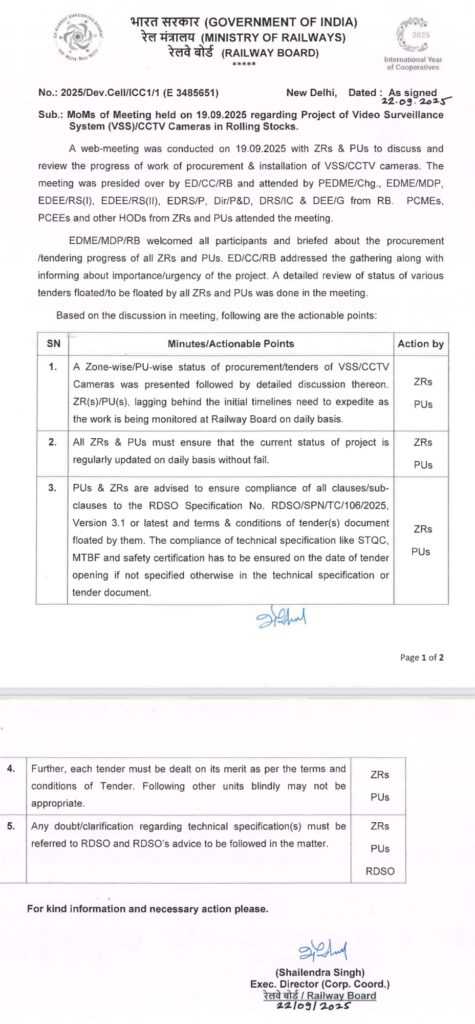
However, the relief was short-lived. The directive was diluted with a caveat: “if not specified otherwise.”
Buried in the fine print, this single clause has given bidders ample leeway to exploit ambiguities. Certain provisions—such as the one requiring #OEM test certificates only at the inspection stage—contradict the spirit of upfront compliance.
Ep108: VSS Project
Industry insiders allege that this drafting is not accidental. “The loophole was left wide open,” said a senior compliance consultant. “It allows bidders to escape scrutiny at the bid stage and shift the burden to inspection, which is too late in the process.”
RDSO’s Narrow Lens
While incorporating such ambiguous clauses, the Research Designs & Standards Organisation (#RDSO) appears to have focused solely on its role as an inspecting agency. From RDSO’s standpoint, obtaining certificates at the time of inspection may suffice. But this narrow lens ignores the purchaser’s perspective entirely.
“How is the purchaser supposed to ensure compliance if the successful bidder fails to produce certificates later? How is a level playing field ensured among competing bidders when some have certificates in hand and others don’t?” asked a retired procurement officer. “Should contracts be finalised merely on the presumption that bidders will be able to deliver later?” These are the fundamental questions the Board has failed to answer.
Adding to the confusion, some Zonal Railways have insisted that certificates be submitted with the bid, while others have not. The lack of uniformity among procurement agencies has created a patchwork of practices, undermining transparency and opening the door for arbitrary interpretation.
Dubious Compliance, Suspect Certificates
In this context, attention is invited to Clause 3.15 of the RDSO specifications, which requires submission of OEM test certificates from a Government/NABL accredited test laboratory such as CFR Chennai under STQC Directorate for MTBF testing. At present, only CFR (Centre for Reliability), Chennai, is accredited for issuance of this certificate. Several bidders have merely asserted “compliance” with this mandatory requirement without producing the requisite certificate. Such claims, unsupported by valid certification, are false and render their offers technically unsuitable.
Similarly, under Clause 3.16 of the specifications, BIS certification for power supply is a mandatory requirement. Certain bidders lacking this certification have nevertheless claimed compliance. Further, Clauses 4.1 (xxiii), 4.1 (xxiv), and 4.2 of the specifications mandate specific regulatory certifications such as BIS/EN/IEC and security verifications. Here too, some bidders have claimed compliance without holding such certifications.
Investigations reveal that many bidders have merely “claimed” compliance without actually submitting documents. The MTBF certificate from the Centre for Reliability, Chennai—the only accredited facility in India—was missing from several bids. BIS certification for power supplies, mandated under Clause 3.16, was also ignored by firms that never held the approval.
“What’s worse, some of the certificates that were submitted are incomplete, questionable, or even forged,” said a former RDSO official on condition of anonymity. “Unless RDSO verifies them, the entire exercise is a sham.”
CLW’s Haste Raises Eyebrows
Despite these glaring deficiencies, Chittaranjan Locomotive Works (#CLW) has rushed to finalise certain contracts. Critics allege this points to vested interests. “Why the unholy haste? Why allow technically unsuitable firms to slip through? It reeks of favoritism,” charged a retired procurement officer.
The Principle at Stake
Legal experts underline the principle: eligibility precedes suitability. A #bidder that lacks mandatory certificates at the time of #Tender opening is ineligible, no matter what is promised later. Relaxing this requirement is tantamount to rewriting the rules in the middle of the game, they argue.
The Stakes: Passenger Safety and Public Money
The risks are enormous. Failure to enforce the rules could derail the entire VSS initiative, jeopardise passenger safety, waste thousands of crores in public money, and drag Railways into another high-profile procurement scandal.
“The Board must take ownership now. Either certificates must be made mandatory at the bid stage, or they should be removed entirely from the specification. One cannot have the cake and eat it too,” said a senior compliance consultant.
Unless the Railway Board closes the loopholes, enforces uniformity across Zonal Railways, and ensures strict verification by RDSO, the flagship #surveillance project may become yet another case study in how procedural lapses and half-hearted clarifications can sink a mega investment.