

How a Duopoly Engineered by IR created havoc in Traction Transformer Repairs—Day light robbery of public exchequer
A repair contract was awarded at an exorbitantly inflated price, wholly disproportionate to the intrinsic value of the work undertaken. As a matter of fact, the cost of new transformer would have been lesser than the repairing cost
“The quality of decision making is too much poor nowadays in Indian Railways”
This is the story of how selected few has risen to dominate a critical segment of #IndianRailways infrastructure through a carefully cultivated duopoly, bureaucratic backing, and alarming levels of influence.
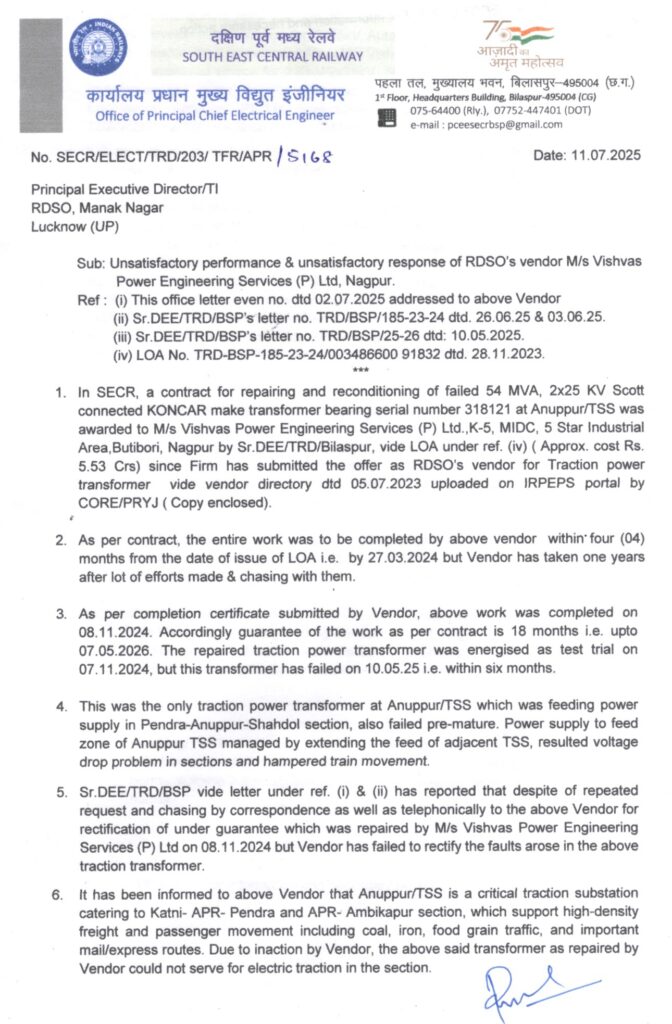
Whereas in March 2023, a #contract was awarded to M/s Vishwas Power Enigineering services Nagpur for the repair and reconditioning of a 54 MVA, 220/2x25kV Scott-connected #traction transformer located at Anuppur Traction Sub-Station (#TSS) in South East Central Railway (#SECR), at a contract value of ₹5.55 Crore.
And, whereas the prevailing cost of a new 100 MVA traction transformer — possessing nearly double the rated capacity — currently stands at approximately ₹8 Crores.
And, whereas upon factoring the prevailing inflationary trend, particularly the substantial escalation in the cost of critical raw materials such as copper over the intervening period of two years, and juxtaposing the rating differential, even a rudimentary arithmetical back-calculation reveals, without a scintilla of doubt, that the said repair contract was awarded at an exorbitantly inflated price, wholly disproportionate to the intrinsic value of the work undertaken. As a matter of fact, cost of new transformer would have been lesser than the repairing cost.
And, whereas the most disturbing aspect lies in the fact that the impugned transformer, upon reinstallation in November 2024, suffered catastrophic failure within a span of merely six months, i.e., in May 2025 — a timeline which gravely undermines both the quality and bona fides of the repair work executed.
Now, therefore, in view of the above disturbing facts, the matter warrants a thorough and dispassionate investigation, both to secure accountability and to uphold probity in public procurement. This failure is not trivial. Traction transformers are static devices with a codal life of 40 years, as per #RailwayBoard standards. These are not “off-the-shelf” items, and rarely fail in normal railway usage due to conservative loading and robust design margins. That the repair failed within six months raises questions not just about technical competence — but also huge loss to the IR.
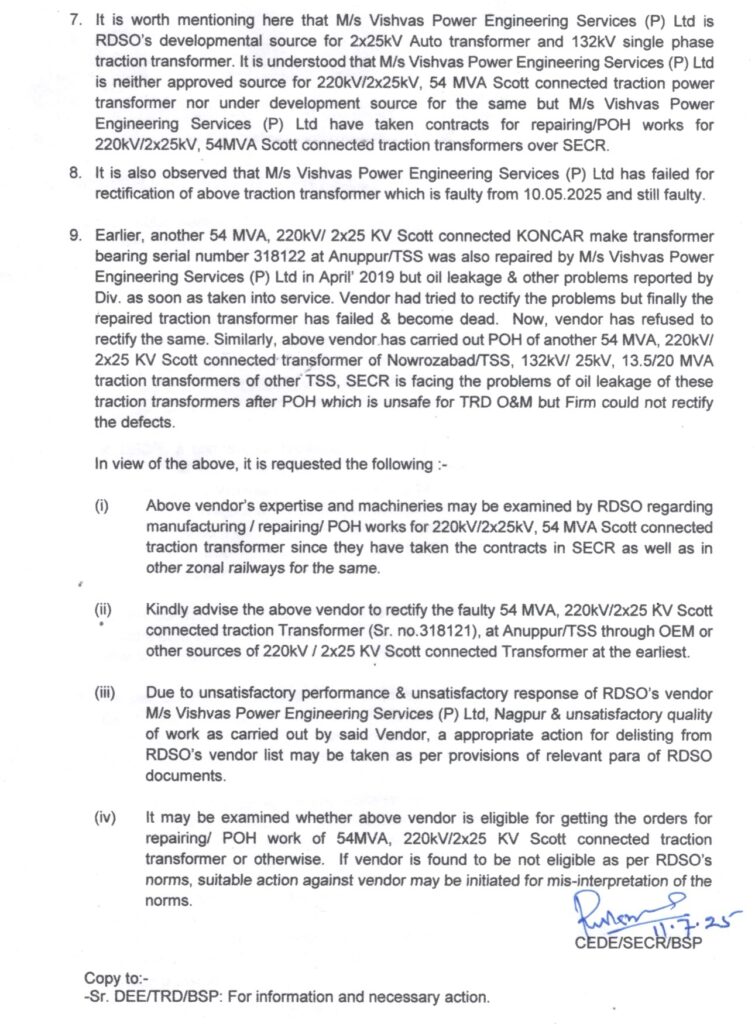
It is further pertinent to note that earlier, another 54 MVA, 220kV/2x25kV Scott-connected traction transformer of #KONČAR make, bearing serial number 318122 and installed at Anuppur TSS, was repaired by the same firm ie. M/s Vishvas Power Engineering Services (P) Ltd, Nagpur in April 2019. However, the said #transformer developed serious defects — including persistent oil leakages and functional anomalies — almost immediately upon re-commissioning.
Despite repeated attempts by the #vendor to effect rectifications, the #transformer ultimately suffered complete failure and became inoperative. Alarmingly, as per #CEDE/SECR, the vendor has since refused to undertake any further remedial action, abandoning responsibility entirely.
Reliable sources say that the vendor’s track record remains consistently deficient. In a similar pattern, M/s Vishvas Power Engineering Services (P) Ltd. carried out #POH (Periodical Overhaul) of another 54 MVA, 220kV/2x25kV Scott-connected transformer at Nowrozabad TSS, along with 132kV/25kV, 13.5/20 MVA traction transformers at other TSS locations under SECR. Post-overhaul, serious oil leakage issues have been observed in these units, posing a significant #Safety hazard to #TRD operations and maintenance.
“Despite the critical nature of these failures, the firm has repeatedly failed to rectify the defects, reflecting both technical incompetence and an alarming disregard for operational safety and contractual obligations”, said a senior officer.
It is a matter of serious concern that the Scott-connected transformer, technologically intricate and highly specialized equipment, was entrusted for repair to a firm which was neither the Original Equipment Manufacturer (#OEM) nor technically approved for undertaking repairs of such sophisticated transformers. “The said firm possessed no prior experience or technical credentials relevant to the repair of Scott-connected transformers”, sources said.
Yet, astonishingly, “the contract was awarded to them solely on the tenuous ground that they held #RDSO approval for routine traction transformers. This justification is patently flawed and technically indefensible, as equating a Scott-connected transformer with conventional traction transformers is akin to comparing apples with mangoes — fundamentally distinct in design, complexity, and operational behaviour”, says an expert.
To aggravate the impropriety further, an exorbitant and unjustifiable repair price was sanctioned in their favour, thereby compounding the error with financial imprudence. Such a course of action not only reflects poor judgement but also raises troubling questions about the integrity of the entire procurement and technical evaluation process. “The quality of decision making is too much poor nowadays in Indian Railways”, says a retired general manager.
It is a well known fact that nearly all #POH and #repair or #maintenance contracts for traction transformers are currently executed by just two firms — M/s Vishvas Power, Nagpur and Shri Abirami Engineering Works, Chennai. Even out of these two, majority works remain with only M/s Vishvas Power, Nagpur, and thus almost maintaining monopolistic regime on IR. Railway Board letter dated 17.05.2005 mandates that only #OEMs or #RDSO-approved vendors be engaged for such work. However, this clause has effectively helped entrench this #duopoly, as most of the major OEMs (including global players like Hitachi, Toshiba, and Prime Meiden) do not participate in such POH/repair contracts.
Despite this, RDSO has not made any serious effort to develop and register independent list of #vendors for POH/Repair of traction transformer. For many field and RDSO officials, the current arrangement offers a convenient “win-win” — a perception that keeps critical scrutiny at bay.
No Accountability—Only Promotions: The officer who sanctioned the repair at exorbitant price and failure within 6 months, #SrDEE/TRD/BSP—Mr. #DSTomar—could not only evade any scrutiny but was later rewarded with even more lucrative posting as #DyCEE/C/BSP in SECR. Instead of investigation, there’s reward.
Conclusion
The creation of a #duopoly in such a strategic #infrastructure segment is not just poor policy — it’s very dangerous too. Indian Railways must urgently reassess its vendor approval processes, and bring in greater #transparency and #accountability in the railway system.